
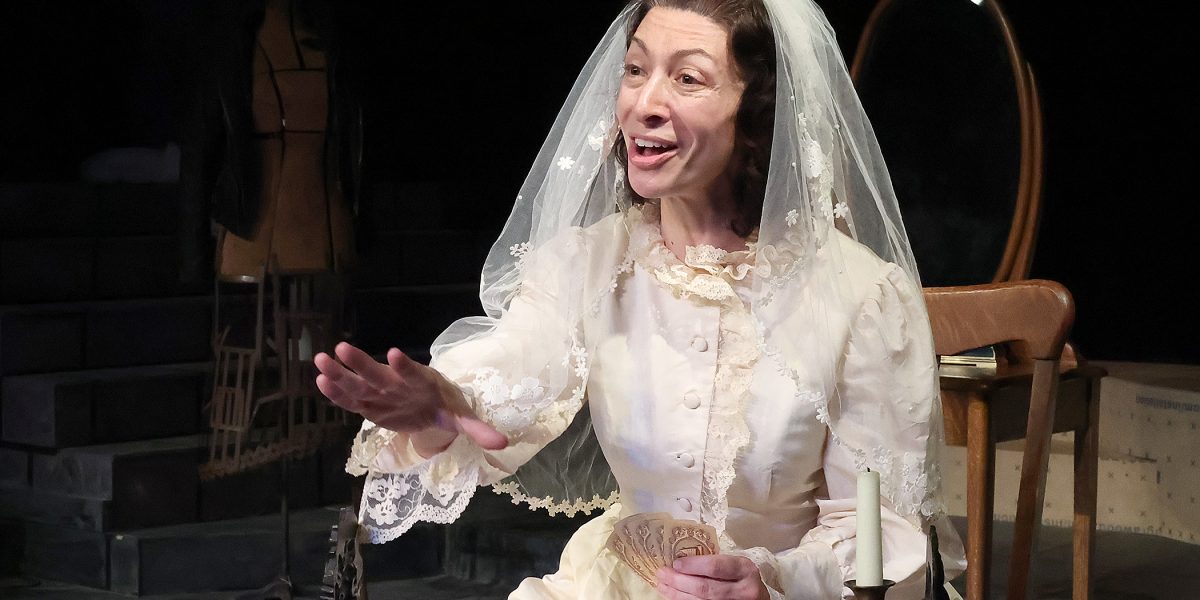
THE BOSTON GLOBE – Watching a drama unfold offers a special kind of thrill. In the case of “(re)Dressing Miss Havisham,” the exhilaration comes not only from this actor’s unexpected exploration of the tragic character from Charles Dickens’s “Great Expectations,” but also from the realization that the play is still in the throes of creation.
At the center of “(re)Dressing Miss Havisham” is an enchanting performance by actor Miranda Jonté (playing herself), who, with award-winning playwright John Minigan (“Noir Hamlet,” “The Legend of Sleepy Hollow”), indulges her passion for true-crime stories by reexamining the cold case of the death of Miss Havisham. As she describes her college major shift from criminology to theater, Jonté draws an amusing but not far-fetched line between an FBI profiler and an actor analyzing a character. The set suggests Miss Havisham’s room in her estate, which was famously frozen in time from the moment her fiancé jilted her in the Dickens novel, but that’s simply the frame for a behind-the-scenes view into all of the elements — research, experience, commitment, imagination, as well as the set and costume — that go into an actor’s effort to bring a character to life on stage.
Jonté is a delightful host who erases any pretense of a fourth wall, inserting humorous asides, asking who in the audience has read the book, soliciting help with getting buttoned into Miss Havisham’s bridal gown, and generally creating the sense that we are helping her piece together an honest portrayal of Miss Havisham, despite what she points out are errors Dickens made. “When the story you’re being told doesn’t match the facts, it’s ‘hinky,’” she explains. “That’s a police term.” The vibe is relaxed, almost conversational, as Jonté invites us into her quest to understand “the how and the why” of Miss Havisham.
As she digs in her “evidence box” and affixes photos to magnets on a “murder board” to build her case, she also regales us with facts about Dickens’s personal life that seep into his novel, including his efforts to discredit his wife so he could pursue an affair with a young actress; his portrayal of Miss Havisham as the archetype of a bitter “old maid”; his use of his final home, Gad’s Hill Place, a place he’d admired since childhood, as the inspiration for Miss Havisham’s Satis House. Despite the red yarn clearly running between the magnets, the images don’t necessarily illuminate Jonté’s investigation so much as create a collection of details an actor uses to build a character.
Minigan’s script gently guides Jonté as she moves from forensic investigator to character and then to actor. We are treated to Jonté trying out several accents before settling on the right one for a scene between Estella, Miss Havisham’s adopted daughter whom she has taught to be cold-hearted; Pip, whose heart Estella has broken; and Miss Havisham, who finally sees the consequences of her vengeful actions.
As she pieces the facts together, Jonté wonders if Miss Havisham decided it would be better to be burned alive than live alone in her 40s. “I’m in my 40s and live alone,” Jonté says. But then she quickly tells us this is her choice, and besides, she has two dogs, so she doesn’t meet the stereotype of a single woman with multiple cats. She makes it a joke, but it also serves as a reminder of the commitment the life of an actor requires. “The work has to be paramount,” she says.
She talks about her studies at Actors Studio, her own commitment to her craft, and her performance as Nina in “The Seagull” at 18. We are treated to a snippet of Nina, a telling reference since Chekhov’s character is so obsessed with her performance, she thinks she is a seagull. Her final revelation comes some years later, when she realizes she is an actress and recommits to persistently pursuing that career.
More than once, Jonté refers to Miss Havisham — and all of us during COVID quarantine — “sitting alone with her imperfections.” It’s such a powerful image, revealing all of our vulnerability and how we persist when great expectations become disappointments. Even though there is a kind of “breakthrough” in the case that neatly wraps up the investigation, it’s Jonté’s vulnerability through her journey that we connect with, more than Miss Havisham’s.
And this may be the loop Jonté and Minigan still need to close to move “(re)Dressing Miss Havisham” from an entertaining actor’s exercise to a deeply moving play about commitment, persistence, and resilience.
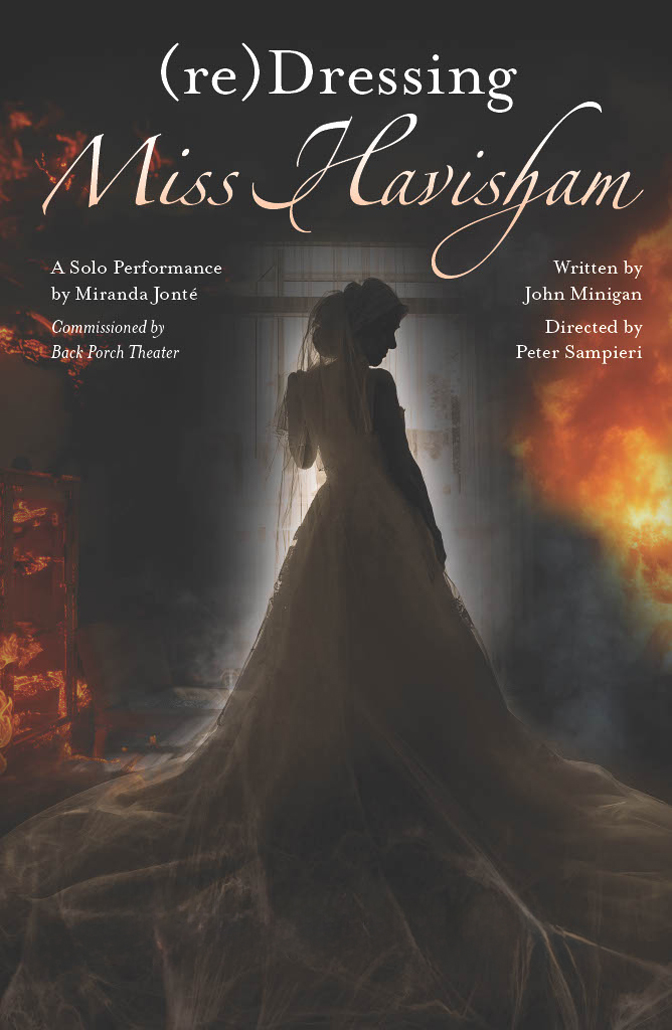
(RE)DRESSING MISS HAVISHAM
A solo performance by Miranda Jonté, written by John Minigan, directed by Peter Sampieri. At Boston Playwrights’ Theatre, May 19–24. Tickets $20–$35. (re)Dressing Miss Havisham
By Terry Byrne
Cover photo: Miranda Jonté in (re)Dressing Miss Havisham, Bob Miranda Tucker/Focal Point Studios