
Boston Playwrights’ Theatre’s Two-Playwright Q&A
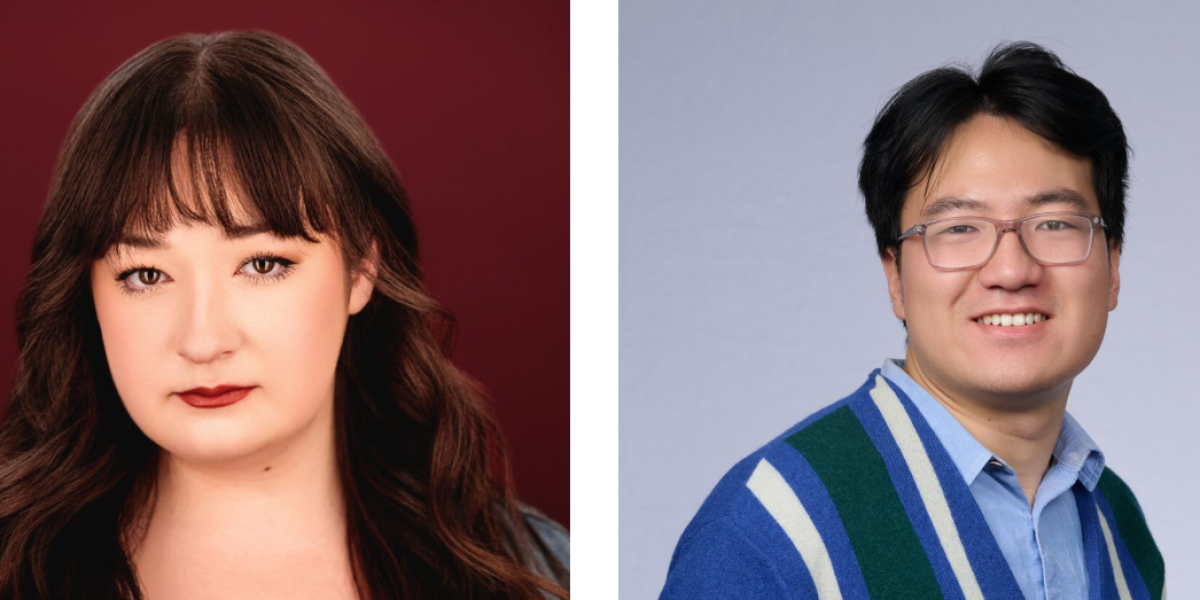
Yide Cai, “White Phoenix” · Rachel Beth Greene, “jessica of venice”
Performing November 5-22, 2026
McGRATHPR.com – Boston Playwrights’ Theatre, Boston University’s award-winning professional theatre dedicated to new work, presents its “Fall Rep Festival,” featuring two new plays running in repertory November 5 through 22, at 949 Commonwealth Avenue, Boston: Yide Cai’s “White Phoenix,” directed by Dmitry Troyanovsky, and Rachel Beth Greene’s “Jessica of Venice,” directed by Josh Glenn-Kayden. The pairing brings together two distinct worlds: a Chinese family torn apart across an ocean, and an Orthodox Jewish community set in the present day. Performed on the same stage, the two plays ask a shared question: what is the cost of crossing the distance between two worlds?
Opening: Two Worlds, Two Forms

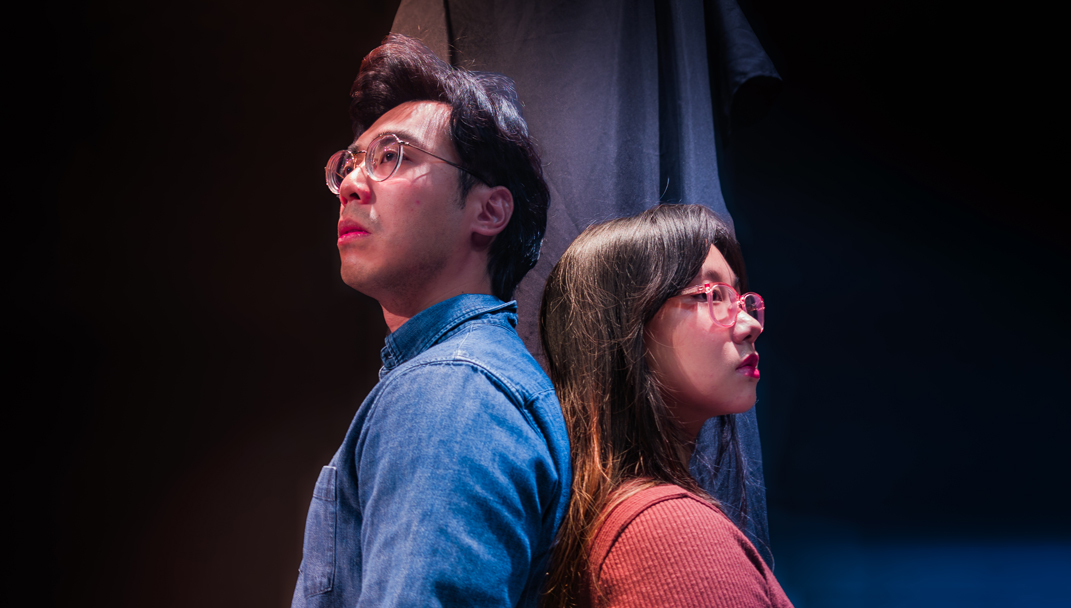
To Yide: “White Phoenix” moves across decades and continents but lives in one room with two actors. What made you trust that two bodies could carry an epic that sprawling — and what does the audience’s imagination have to do that a bigger production would do for them?
Response: “The play is a two-hander, and that’s its strength. It crystallizes the world and the characters’ relationships. Everything — the time, the places, the politics, the history — is funneled through what is happening between two individuals in that specific moment. The transformation has to be embodied and internalized in the actors’ performance, rather than achieved through external casting and sets.
This structure also holds a tension with the play’s message. Even though the two siblings spend the entire play trying to find each other, the two actors playing them are together on stage the whole time. And even though the play spans many places and years, the actors remain in the same space, in the present.
In this way, the play is inherently theatrical. I always believe a play should have devices that make it belong only on stage. The audience will serve as witness to the effort of two actors embodying four distinct, almost opposite characters. It’s this magic of making something out of nothing. That’s what’s always special about theater: the imagination. Calling back to Shakespeare, in his time, plays were performed in daylight, in the open air, but a character could simply say ‘it is night.'”
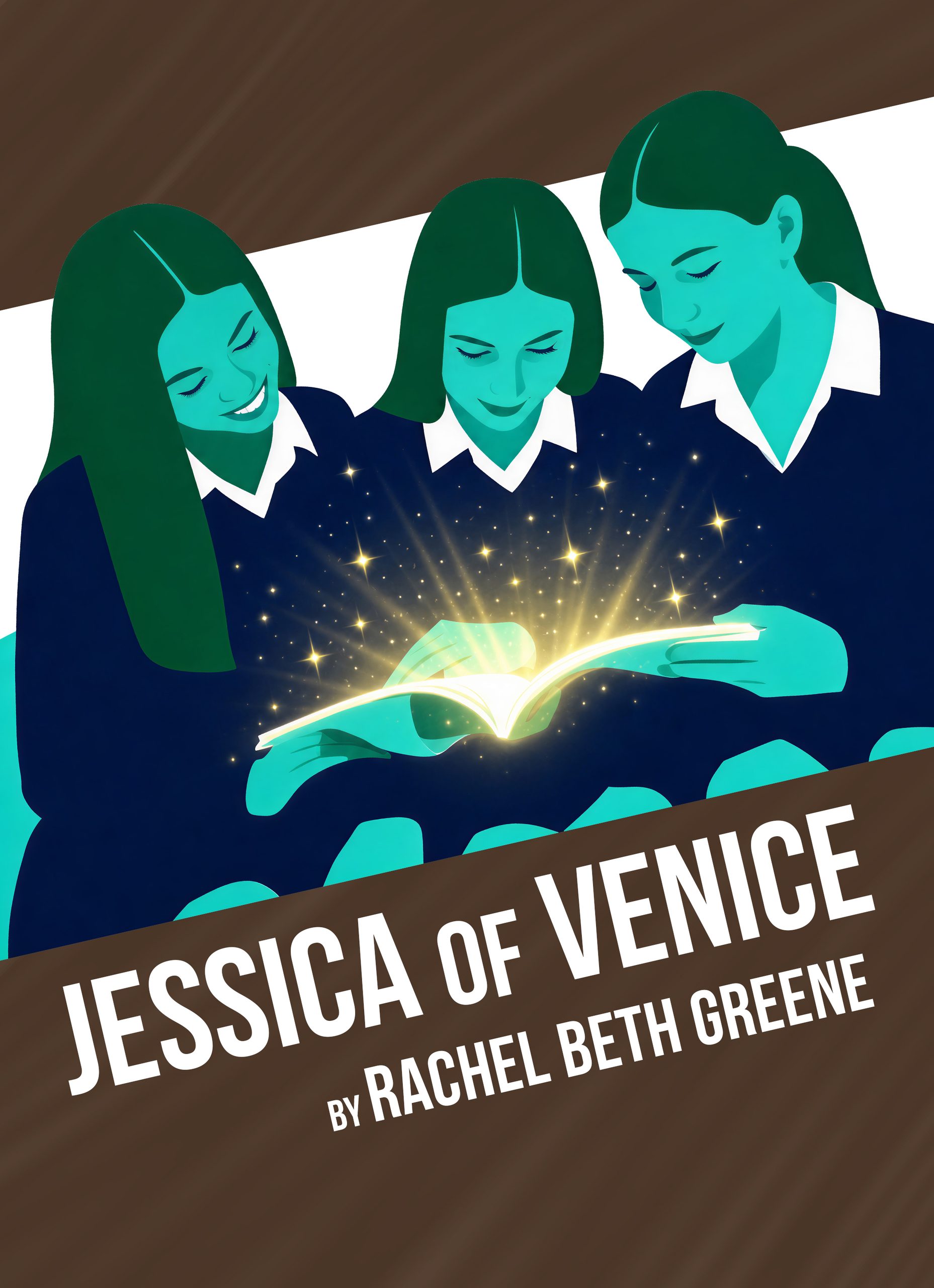
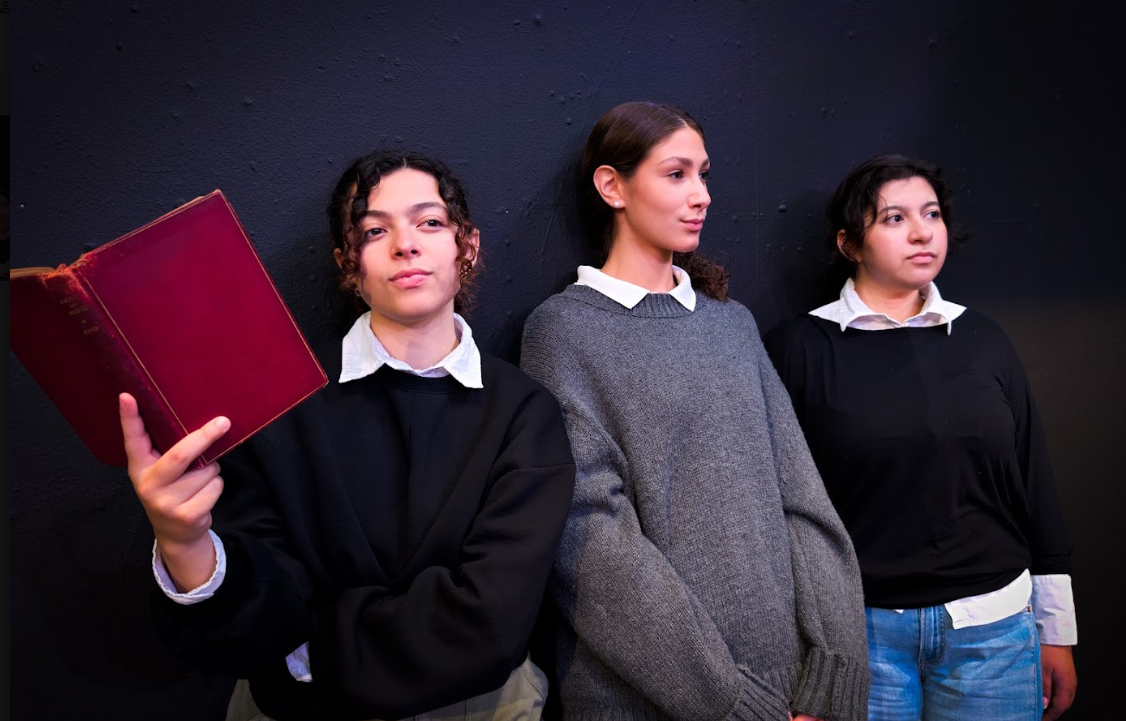
To Rachel: “jessica of venice” also collapses a huge world into a small space — a forgotten library, a handful of schoolgirls. What drew you to a story of confinement and the notion of wanting out of that circumstance?
Response: “I am a Shakespeare buff at heart, and I am particularly drawn to his young female characters. Jessica (from The Merchant of Venice) has always fascinated me. Her portrayal onstage is typically positioned in opposition to Shylock; in the prevailing contemporary interpretation of the play, Shylock is a tortured, abused hero, and as such, Jessica is so often portrayed as selfish and coldhearted towards her father. But rarely is she considered within her context: as a curious, sheltered young girl with big dreams. I too was raised in the observant Jewish world and understand how it feels to struggle with the practices of traditional religious life as an ambitious, inquisitive teenager. I am excited to use this play to bring Jessica’s story into the modern day and consider why a hungry young girl might do what she does.”
On Inheritance and Source Material
To Rachel: You’ve taken a 400-year-old play and handed it to teenagers who aren’t supposed to be reading it. What does Shakespeare’s Jessica give Shaina that a contemporary story couldn’t — and what were you wrestling with in adapting a text that has such a fraught history for Jewish audiences?
Response: “I have always been drawn to these minor female characters in stories of men; sure, there is plenty of contemporary media that puts ambitions women front and center. But what is even more true to the experience of religious girlhood is the idea of being a minor character existing at the will of powerful men, and, despite all odds, rising above and claim one’s own agency. This sort of textual excavation work also has its place in Jewish torah study; much of the learning these girls would do in school would be close readings of biblical texts (which, similarly, center on male protagonists), and reading between the lines (via commentators, myths, and imagination) to expand their understanding of the world. I imagine that an ambitious, religious academic like Shaina would be drawn to Shakespeare’s works in the same way that I was at her age; she would see – much like I did – fertile ground for excavation, exploration, and expansion.”
To Yide: Your play has no single canonical text behind it, but it carries an inheritance too — the entangled history of two nations. When you’re writing about a family whose relationships are meant to mirror geopolitics, how do you keep people from becoming symbols?
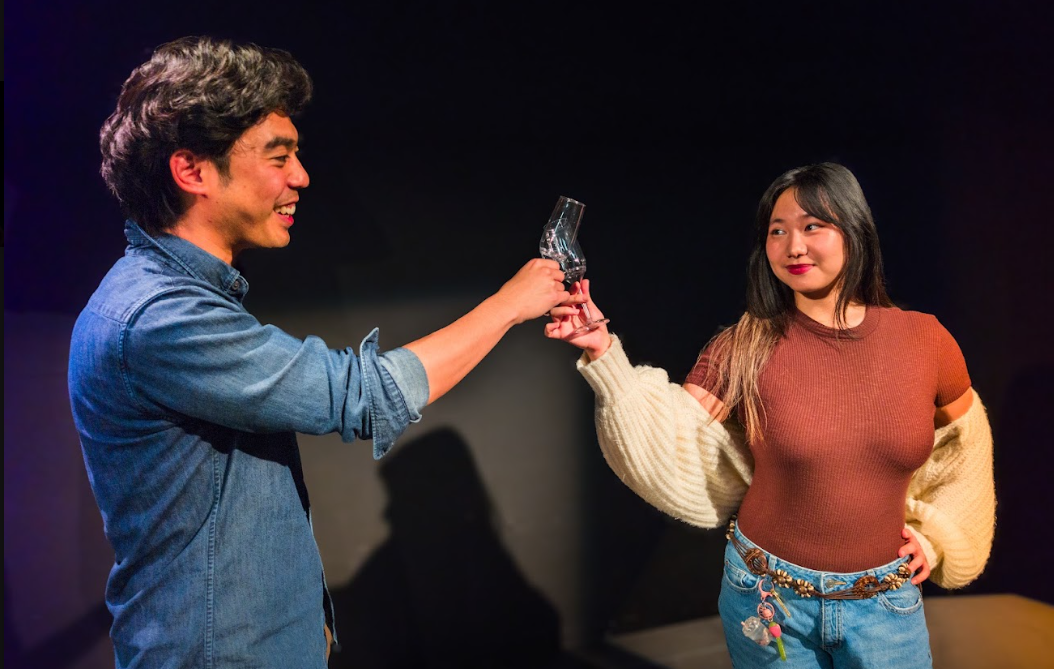
Response: “This play carries influences from classical Chinese drama I’m fond of, particularly The Peony Pavilion. It centers three families: the two siblings, Gabriel’s American family, and YanYan’s Chinese family. When I write about them, it’s clear to me that they are swept up within history and its movements rather than embodying these ideas. Instead of symbols, they are the opposite: prisoners and victims of the countries they belong to.
In fact, this is a bias I’m deliberately writing against. We tend to assume the country or the government and the people who live in it are the same thing, and we treat nations like individuals: “America wants this,” “China wants that.” I think that is an inaccurate generalization and worth criticizing.
I think the symbolism in the play lives more in the characters’ relationships with each other. Aside from the siblings, the other two relationships, between YanYan and CunYi, and between Annie and Gabriel, are intimate but also forbidden. They both need something from each other that they can’t face or confront. I think this dynamic captures well what I understand China and America’s relationship to be. There is China everywhere in America — TikTok, Bubble Tea, Rare Earth — and America everywhere in China — Starbucks, Hollywood movies, and so on. But neither side really wants to talk about it as what it is.”
On the Central Figure Who Wants to Leave
To Rachel: Shaina dreams of a world just past the edge of her community. Did you set out to write a runaway, or did you discover her wanting to leave as you wrote? And where do your sympathies sit — with her, or with the home she’s tearing herself from?
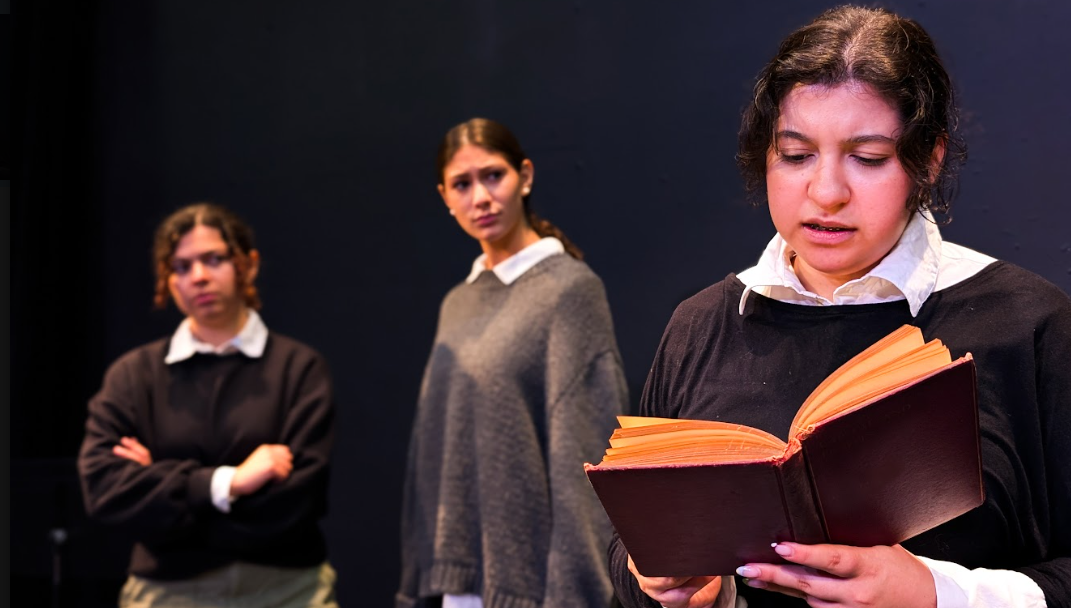
Response: “The original spark for this play was the image of three Hasidic teenagers huddled around a book they were never meant to read. That book being Shakespeare’s The Merchant of Venice, and the runaway concept, came later.
The question of where my sympathies sit is one that I revisit with fresh eyes every day. The easiest answer I can give is: both, of course. Each of these characters is imperfect, and their tact less than impeccable. But both parties – our rebellious protagonist, and her traditional community – fiercely believe they know what is best for Shaina (and themselves). I don’t believe this play has a ‘bad guy,’ in the traditional sense. I believe these characters all act from a place of good, if often mismatched, intentions.”
To Yide: CunYi makes a promise to reunite with a sister who’s been carried to the other side of the world. His entire arc is a refusal to let go. What are the challenges of writing a character defined by holding on? (in contrast to one like CunXin, like Shaina in Rachel’s play, that is defined by longing to break away?)
Response: “In my view, reunion is the objective for both CunYi and his sister CunXin. The play works almost like a Greek tragedy: it begins with a flaw. The Bradfords adopt only CunXin, when they could have adopted both siblings. And that choice causes the separation.
From there, both CunYi and CunXin are defeated by their very own act of striving. They want to reunite so badly, and make so many compromises and sacrifices toward it, that the striving itself changes them into different people, so that even reunion can’t give them back what they lost.
The challenge for me, then, is to track their growth while keeping their underlying desire constant. For CunYi, it begins as a childish promise he has no idea how to keep; then, when he’s imprisoned after Tiananmen Square, he believes he has already failed. For CunXin, when she’s in the hospital, Gabriel mocks her attachment to her brother, telling her it’s basically imaginary at this point. But when she sees CunYi on TV, he suddenly becomes real to her — almost within reach.
So I’m working with a dynamic where the desire stays constant while the context, and the agency each character is given, keep shifting throughout the play.”
courtesy image
On Politics Inside Intimacy
To Yide: You describe the China–America partnership as “conflicted, intense, and incestuous.” That’s a provocative frame to literalize inside a family. What can a love story or a sibling bond say about geopolitics that an op-ed can’t?
Response: “Whenever a news article or academic paper takes on this subject, it’s always in an elevated, abstract, removed language — just cost and benefit. What this play does is physicalize it into something you can see and feel: real relationships between human beings.
Romance and sibling bonds, too, are things we understand instinctively. They become a natural way into the world of this play for the audience. My hope is that even an audience with no knowledge of that time period or its specific background can still understand the play through these characters that it works as a complete story on its own, without needing the politics in mind.”
To Rachel: Your politics are quieter but no less charged — religion, assimilation, a Christian boy from drivers-ed. How conscious are you of the audience’s outside knowledge of these communities, and do you write toward it, against it, or around it?
Response: “I am acutely aware that most audience members will have never set foot in a Hasidic Jewish community, and I am constantly tweaking the language and content in consideration of that. I am endeavoring to strike the magical balance between depicting the Orthodox Jewish community with respect and authenticity, while still opening the doors to outsiders to step into the room and engage. Audiences should expect not to know every single word spoken onstage. But if I’ve done my job right, that will not stand in the way of them understanding the story – in fact, it might even help.”
On Craft and Structure
To Yide: Parallel storylines that converge is a high-wire structural bet — the audience must hold two worlds until they collide. How did you manage the tension of that convergence in the writing? What told you the timing was right?
Response: “It certainly required a lot of finesse and adjustment. The order of the scenes has changed a great deal from one draft to the next. But I always try to maintain a balance between the scenes with CunYi in China and the scenes with CunXin in America, moving back and forth between them. In these paired scenes, the siblings are usually at a parallel junction in their lives, each getting one step closer to the other. For example, right after CunYi learns there’s a way YanYan can help him reach his sister, the next scene reveals that CunXin’s American parents could have adopted both of them all along. So the scenes are sequential in time, but also parallel in the siblings’ respective situations.”
To Rachel: You describe the line between “harsh reality and forbidden fiction” beginning to blur. Practically, on the page, how do you stage that blur — how does the audience feel the tightrope Shaina is walking rather than just watch it?
Response: “Thankfully I get to defer to my trusted director and talented designers when it comes to staging that magic! In terms of my work on the page, though, this is where having a source text (for us, The Merchant of Venice), comes in handy. Seeing the events of Shakespeare’s play begin to mirror in Shaina’s life creates a blurring of reality – what is “real”? What is fiction? And how far away from one another are they, really?”
On the Room and the Collaborators
To Rachel: This is a rep festival — your play shares a stage, a season, and an audience with Yide’s. Having now seen what sits beside you, what conversation do you hope the two plays strike up that neither would start alone?
Response: “There are so many differences between our two plays. But a theme we have discovered that runs between our stories is the idea of characters who inhabit two separate worlds, and the yearning to reach though the space between them. If audiences attend both plays (which I hope they will!), I imagine they will walk away with parallel theme at the front of their mind.”
To Yide: Same question from your side: what does “White Phoenix” look like differently to you knowing it’s playing in rep with “jessica of venice”?
Response: “Having Rachel as my classmate in this cohort has opened up a world I never knew before. I’ve always appreciated her passion and generosity. Staging the two plays together makes me think there is no heaven on earth — no magic escape, no grand mission that simply solves everything. Heaven is in the making, in the everyday life we already have, with the people already around us. The moment we idolize or covet an elsewhere, or an “other,” we create our own downfall. It’s important to accept ourselves, instead of quietly trying to erase who we are in pursuit of becoming someone else we don’t even really know.”
Closing: The Wound Underneath
To both Rachel and Yide: Both of your plays are, at bottom, about the violence of separation — a sibling split across an ocean, a girl ripping herself from the home that made her. When you finished writing, did you land on the side of the “cost was worth it,” or “look what it cost?” Or did the play refuse to decide for you?
Rachel’s Response: “I don’t think I can answer that question, and perhaps neither can the play. These conflicts are too intricate and fraught for a “right answer.” What is right for Shaina may not be right for her best friend, Aliza, or her mother, Rivka. Or, maybe, it is. Either way, I hope the audience leaves the theater pondering this very question.”
Yide’s Response: “For me, the question is less about whether the cost was worth it, and more about the cover-up — or normalization — of that cost, because, for my play, it was never the characters’ choice to begin with. The cost has already been paid, and they spend the rest of their lives trying to recover from it, only to find that recovery is impossible. And the cost is even dressed up as gifts and something they should be grateful for like being adopted to America. These wounds are all covered with acts of charity, and economic posterity, and post-Cold-War optimism. Only now we start to see these wounds we already laid out back in the 90s.
It’s rare that we get to choose the paths of our lives and know their cost in advance. Most of the time, I think, we are swayed by the waves of society and history, and people only draw conclusions once everything is already settled. Before we ask whether the cost was worth it, we need to acknowledge and honor the cost, and the suffering of the people who bore it.”


Q&A drafted on behalf of Boston Playwrights’ Theatre by Michelle McGrath, founding president of Michelle McGrath PR | Media Relations, providing visibility for the arts and culture, nonprofit, and small business sectors, spanning the traditional, digital, and social media landscape since 2009. mcgrathpr.com