
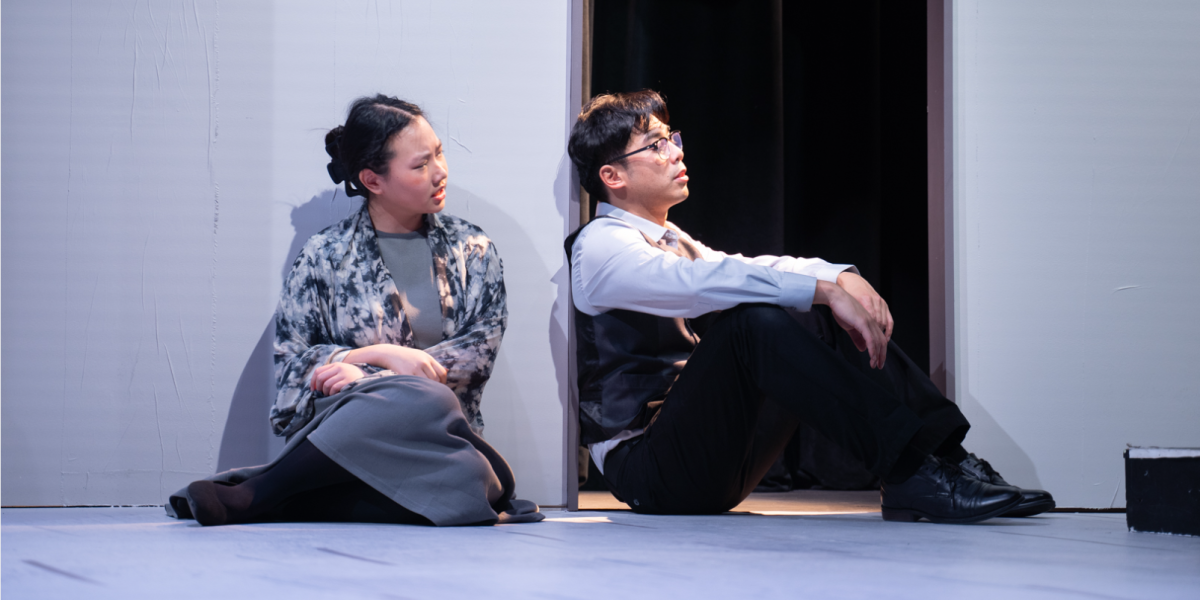
NETHEATREGEEK.com – It is 1980 in Nanjing, Jiangsu, China. Orphaned siblings Li CunYi (Phillip Zeng) and Li CunXin (Serena Zhu) become separated when CunXin is adopted to America. They make a promise to never forget who they are and to somehow find a way back together. In the intervening decade, CunYi moves up the ranks of the Communist Party of China with the help and machinations of boss-turned-fiancée, the conniving politico nepo baby Zhao YanYan (also Serena Zhu).
Meanwhile in America, CunXin—now Annie Bradford—gets her seat at the table by playing ball with the Bradford senatorial dynasty. She is groomed by papa Bradford to be a grateful yellow mascot and groomed by brother Gabriel (also Phillip Zeng) for a Woody Allen-esque incestuous sexcapade. When Clinton wins the US presidency in 1992, trade negotiations make it possible for the siblings to reunite. Yet the reunion that beat impossible odds reveals the rift between their adult selves and the two countries to which they now belong.
The play is inspired by the Ming Dynasty love story Peony Pavilion, in which two people’s boundless yearning for each other transgresses the limits of time, space, even death. It also uses the conceit of a painting of a White Phoenix sitting on top of a snowy mountain, i.e. a blank wall. In an early scene, Zhao YanYan brushes water onto a white wall and says wryly, “every time you look at this painting you are a different person.”
The White Phoenix script has also undergone countless transformations during playwright YiDe Cai’s 3-year MFA program. So White Phoenix is like the White Phoenix’s onlooker. Or is White Phoenix Cai’s White Phoenix, and the playwright is the one who has transformed through the iterations?
Anyway, any reviewer can speak to what worked and didn’t work about the production and the script. Instead, I will reflect as someone who came here from Nanjing, Jiangsu, China as a child, in 1991.
The night before coming to America, I was with my mother, my aunt, uncle and cousin, at our grandparents’ house. I remember my cousin and I playing with a big bucket of LEGOs. My cousin asked me when I would come back. I told her with complete confidence that I’d return in ten years. I don’t remember that conversation at all. Only, my grandmother told me later that when ten years was up, my cousin asked her why I wasn’t back yet.
Last week I bought a box of Apple Jacks because it reminded me of the time my first grade teacher asked the class what we ate for breakfast. I raised my hand and said “Apple Jacks,” happy to finally have a culturally competent answer. The boy next to me shouted, “no you don’t, you eat rice for breakfast!”
A middle school classmate once told me apropos of nothing, “in WWII my grandpa’s job was to kill people like you.” I responded, “I know it’s hard to tell the difference, but I’m not German.” That punchline didn’t really happen, but it always landed at shows when I was a standup comedian.
People always ask me if I miss having siblings because of the one-child policy. I always say that I can’t really miss an experience I never had. What I seem to miss though, is the felt sense of extended family and community. A wide network of people who would have witnessed and mirrored my humanity as a given and helped establish my sense of self as a child. I don’t recall explicit memories; it’s like my body remembers what it had before and hungers for it again.
Ambiguous loss is a loss with no clarity or closure, like when a loved one is still alive but you have no way of reaching them. Disenfranchised grief is mourning with no socially acceptable outlet, like when you miss your family but everyone around you expects you to bootstrap and be grateful. How do you cope with a profound loss that’s rendered invisible? I often thought I was looking for my grandfather in every lover’s face. And even when I found it, one person’s boundless love wasn’t enough.
Anne Anlin Cheng developed the concept of Ornamentalism to describe the particular ways Asian femininity is orientalized in western culture as a decorative ‘person-thing’ that can be put on and taken off like a mascot costume. It is a particular and paradoxical form of abjection that exalts your racialized body while denying your interior life.
In An Indigenous Peoples’ History of the United States, Roxanne Dunbar-Ortiz situates America’s Pacific Wars squarely within the racial logic of genocide. She describes the foundation of the US as a nation built on the systematic land theft and extermination of Indigenous peoples, how colonial expansion that began in the Indian Wars kept going from the Spanish-American Wars to Vietnam to Afghanistan. For this great nation to keep existing, there has to be an Other to keep being eradicated.
I don’t know how to exist in a society whose central dogma is to kill people like me and wear my skin. Sometimes I wonder if I’ve done that to myself, cell by cell, year by year. Because even though I don’t know how to live, I know I can’t go back. And I know I don’t want to die.
I know there is another version of me who never left and sometimes something makes me think about how different from me that person might have been. If I met her, I probably wouldn’t even be able to comprehend her interiority. Or maybe she’d have the same issues in a different form.
To the actors: These are the roles that build character. Commit to the bit and go for every lead role with the entitlement of a mediocre white man.
To the playwright: Keep writing. The emotional core of your work resonates deeply. Keep existing in your snarky ungrateful subjectivity. It helps me to keep existing in mine.
Presented by Boston Playwrights’ Theatre
Written by YiDe Cai
Directed by Dmitry Troyanovsky
Featuring: Phillip Zeng, Serena Zhu
Article by Diana Lu
November 5 – 22, 2026
Snodgrass Stage
949 Commonwealth Ave
Boston, MA 02215
Approximate run-time: 90 minutes, no intermission
Photo: Serena Zhu and Phillip Zeng. in Yide Cai’s “White Phoenix,” image by Scornavacca Photography