

The fast-growing population is glaringly absent onstage this season
BOSTONGLOBE.com – We’re now two months into Boston’s 2026-27 theater season, and local productions about the lives of Asian-Americans have been, so far as I can tell, virtually nonexistent.
Don’t hold your breath waiting for any surge of onstage representations of the fast-growing ethnic group between now and June 1, either.
Economically, politically, and socially, Asian-Americans have made enormous strides in Boston, statewide, and across the country. But you sure wouldn’t know it from what’s presented in local or Broadway theaters.
The dismal fact is that the 2026-27 season will contain the merest handful of plays or musicals in the Boston area that will focus on the Asian-American experience — and none of them will be at the region’s leading theaters.
Don’t look to Broadway for good news, either. Of the 32 current productions, only one — “Maybe Happy Ending” — could be called Asian-themed, and it’s a musical about robots in South Korea who fall in love, not about life as it is lived by Asian-Americans. Moreover, of 22 new productions slated so far to debut this season on Broadway, none appear to focus on the lives of Asian-Americans.
Taken in aggregate, this vacuum makes a damning statement about how low Asian-American stories rank on the American theater’s list of priorities.
In terms of representation, it’s inexcusable that so many voices will be unheard and so many narratives untold, especially considering how avidly theater leaders style themselves as champions of diversity.
In terms of business strategy, it’s inexplicable, given that those same leaders consistently cite audience development as a top priority. Have they failed to notice that the number of Asian-Americans has reached record highs in Boston — governed by Mayor Michelle Wu, the daughter of Taiwanese immigrants — and in the state?
In Boston, Asian-Americans constitute more than 10 percent of the city’s population, and in Massachusetts overall, 8.5 percent, according to the US Census Bureau. Nationally, the Census found that the number of Asian-Americans has reached 7 percent of the population.
But onstage, the visibility of Asian-Americans is not remotely commensurate with their presence in the community.
Let’s stipulate a few things. First, it’s not as if plays and musicals by and about Asian-Americans have been absent from Boston-area stages or on Broadway over the past decade. There have been some honorable efforts, and other works are in the pipeline. Second, there are only so many productions any individual company or Broadway playhouse can present in a season. Third, audiences go to the theater for a host of reasons, not solely to see reflections of their own lives.
But surely one of the most populous ethnic groups in the country has a right to expect more from an art form that prides itself on dramatizing the way we live now. It’s reasonable for them to believe that the theater would try a lot harder to explore the challenges, the changes, and the array of culturally specific experiences that shape them. What they are subjected to instead is underrepresentation.
During the nine-month theater season that kicked off at the beginning of September, no plays or musicals that are specifically focused on Asian-American life are scheduled at the American Repertory Theater, The Huntington (which has two venues at its disposal), the Emerson Colonial Theatre, the Boch Center Wang Theatre, the Boch Center Shubert Theatre, SpeakEasy Stage Company, Lyric Stage Boston, the Charles Playhouse, or ArtsEmerson, whose venues include both a mainstage and a black-box theater in the Emerson Paramount Center as well as the spacious Emerson Cutler Majestic Theatre.
Your search for specifically Asian-American programming this season will be equally unavailing at Merrimack Repertory Theatre in Lowell, Greater Boston Stage Company in Stoneham, Umbrella Stage Company in Concord, Apollinaire Theatre Company in Chelsea, or Actors’ Shakespeare Project in Watertown(which presents contemporary plays along with the works of its namesake playwright).
At theaters primarily known for their summer seasons, the story was the same this year. There were no works focusing on Asian-Americans this past summer at North Shore Music Theatre in Beverly or at Gloucester Stage Company.
What of the Berkshires, where theatergoers from New England, New York, and beyond flock from June to September, eager to check out the latest in contemporary drama or stylish revivals of classics? Nope.
Present-day Asian-American life or history was not the subject of productions by Berkshire Theatre Group, which operates theaters in Stockbridge and Pittsfield; at venues operated by Pittsfield-based Barrington Stage Company; or at any of the Lenox stages programmed by Shakespeare & Company, which presents contemporary plays as well as those by the Bard of Avon. (Williamstown Theatre Festival, which is in the midst of a reinvention, canceled its 2026 season.)
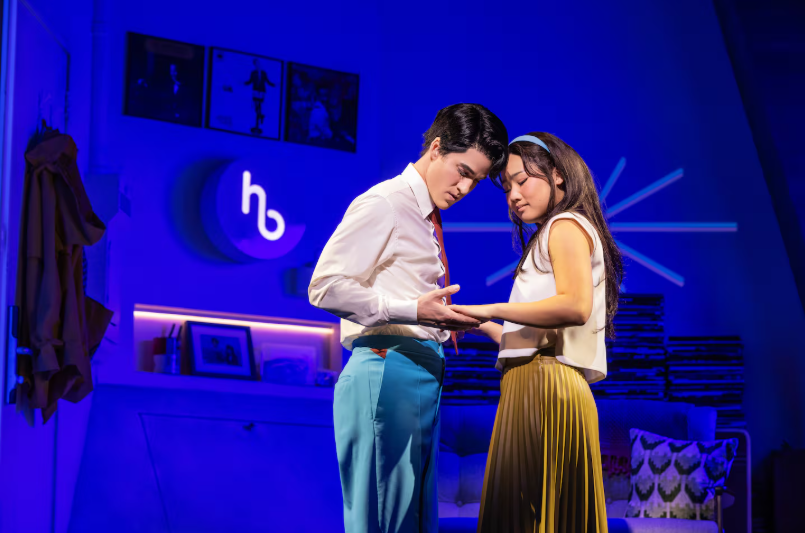
The most high-profile Asian-themed production in the Boston area this season will likely be the Tony-winning “Maybe Happy Ending,” to be presented by Broadway In Boston at Citizens Opera House. Lyric Stage’s schedule includes “King James,” by the prominent dramatist Rajiv Joseph (“Bengal Tiger at the Baghdad Zoo”), whose father is Indian. But Joseph’s play is about a young Black man and a young white man who bond over their admiration for LeBron James. The Wang Theatre will again host Shen Yun, a dance troupe that focuses on classical Chinese dance, not the Asian-American experience.
The situation will be brighter at some of Boston’s smaller theaters this season.
Boston-based CHUANG Stage, which was specifically founded to “cultivate joyful and radical Asian American stories,” will stage Alex Lin’s “Laowang,” which “explores the changing face of America’s Chinatowns” through the tale of a matriarch leading her family in a fight against a developer’s attempt to buy out their restaurant. (Through Sat., Oct. 31, CHUANG Stage is running “The Sitayana,” a female-focused reimagining of “The Ramayana,” the Sanskrit epic poem. Several months ago, CHUANG Stage presented Minna Lee’s “My Home on the Moon,” an ingenious sci-fi comedy about a family-run Vietnamese restaurant resisting the powers of gentrification and, it turns out, much more.)

Company One Theatre has paid attention to works by and about Asian-Americans over the years. Last year, the troupe teamed up with CHUANG Stage for “Learning to Read by Moonlight,” a play — spoken in both English and Tagalog with subtitles — about an undocumented Filipino-American boy and his mother struggling to make their way in New York amid anti-immigrant fervor. (A spokesperson for Company One said its 2026-27 lineup has not yet been finalized.)

In November, Boston Playwrights’ Theatre will stage Yide Cai’s “White Phoenix,” about the long-delayed reunion between a brother and sister raised apart — he in China, now romantically involved with the daughter of a powerful political family; she in America, having been adopted into the family of a US senator and also in a complicated romance.
In a spring production of the long-established musical “Working” by the Front Porch Arts Collective and Central Square Theater, the stories of immigrant workers in Boston will be included, at least one of which will focus on an Asian-American experience.
For two nights in January, according to its website, Cambridge’s Multicultural Arts Center will present “Barbed Wire,” a new play by Japanese-American dramatist Rosanna Yamagiwa Alfaro and Black playwright Mary E. McCullough, about the friendship forged between a young Japanese-American inmate at a World War II internment camp and a Black soldier who is stationed at the camp. In February, Wheelock Family Theatre will stage “When You Trap a Tiger,” Katie Hae Leo’s adaptation of Tae Keller’s novel about three generations of women in a Korean-American family that finds itself in a space “where myth and memory intertwine.”
All worthy-sounding efforts, but their audiences don’t approach those at the larger theaters. The bottom line is that Boston-area theater needs to sharpen its mission when it comes to reaching a too-neglected Asian-American constituency. A few suggestions:
Festivals
A group of theater companies should band together to create separate productions of an Asian-American playwright’s works, such as has been occurring locally over the last couple of years with “The Ufot Family Cycle,” Mfoniso Udofia’s nine-play saga following three generations of a Nigerian-American family.
Amplifying a single voice
Or a single ambitious company could build an entire season around works by a single Asian-American playwright. Possible examples could include Lauren Yee, Lloyd Suh, David Henry Hwang, Young Jean Lee, Chay Yew, Philip Kan Gotanda, Jiehae Park, Christopher Chen, or Jeanne Sakata.
Commissions of new works
More theaters should commission playwrights to create new works that examine the history and present-day experience of Asian-Americans in Boston and elsewhere. A spokesperson for The Huntington said the theater is developing works by Suh, who is Korean-American, and by Indian-American playwright Mahira Kakkar. But no production of either is scheduled before June 1.
Merrimack Rep, in Lowell, which has a large Cambodian immigrant population, is slated to hosta workshop reading of the second part of the “Letters From Home” trilogy by Cambodian-American playwright-actor Kalean Ung. (Earlier this year, Merrimack Rep presented “Kween,” by Cambodian-American playwright Vichet Chum, about the experiences of an immigrant family from Cambodia.)
Collaborations with CHUANG Stage
In its decade of existence, the Front Porch Arts Collective, a Black theater company, has contributed immeasurably to the diversity and overall quality of theater in the city — initially via coproductions with established theater companies, and now by producing work on its own. Established organizations should seek opportunities to collaborate with CHUANG Stage, in search of the kind of new voices and fresh perspectives the city’s Asian-American theater company can provide.
Artistic leadership
The ranks of Asian-American artistic directors are exceedingly thin in Boston and beyond. When it comes time to hire a new artistic director, theater boards of directors need to do a much better job recruiting Asian-American candidates. The crucial next step is to empower them to program seasons that are more inclusive than the abysmally unrepresentative one we’re currently in.
By Donald Aucoin, Boston Globe Theater Critic