
PILOT CATHOLIC NEWS.com – Judge Raymond P. Moore discovered his fifth cousin was the pope at the same time everyone else did.
The federal judge and Boston native was reading an article in The New York Times about Pope Leo XIV’s Louisiana Creole roots when he saw his mother’s maiden name. As soon as he saw that, he knew.
“I thought it was fascinating, and more than that, I knew how much it would mean to people in New Orleans,” he told The Pilot.
Moore’s mother was Anne Lemelle. Her lineage can be traced back to Francois Lemelle, whose brother married a woman named Celeste de Grandpre. Their daughter, Celeste Lemelle, is a distant ancestor of Pope Leo XIV. That makes the pope and the judge double fifth cousins. Moore did not know about his cousin until he was elected pope. He doubts that the pope knows about him. His kids like to tease him about his distant relative.
“I have a bunch of cousins,” he said. “We talk about it and keep in touch. It’s a big deal, and I don’t want to make it sound like it’s not, but it came upon me the same way it came upon everybody else.”
While Pope Leo XIV’s Creole ancestors migrated to Chicago for better opportunities, Moore’s moved to Boston after World War II. His was a typical Boston Catholic childhood.
“Altar boy, choir boy, whole bit,” he recalled.
He was born in Roxbury and grew up in the Ruth Barclay housing project in the South End, right next to the Cathedral of the Holy Cross. Three portraits hung in his living room: Jesus, the pope, and John F. Kennedy.
Moore said that if his mother knew he was related to the pope, she would cry, drop dead, or both.
“Her family was as Catholic as Catholic can get,” he said.
Moore has been researching the Lemelle family for over 40 years. His family tree, and by extension Pope Leo XIV’s, is complicated. Some of their ancestors were enslaved, while others were enslavers. Some were both. The pope’s family tree is a vast, elaborate tangle of Louisiana Creole, Cuban, Italian, French, Czech, and Spanish roots.
“I think it says that is the American experience,” Moore said.
Moore talked to The Pilot while sitting in a conference room inside the Newbury Street headquarters of American Ancestors, the oldest and largest genealogical society in the U.S. He was surrounded by portraits of the Protestant Yankees who founded American Ancestors in the mid-1800s. They likely never would have suspected that someday, the society they founded to trace their blue-blooded roots would produce a family tree of the pope and his mixed-race ancestry.

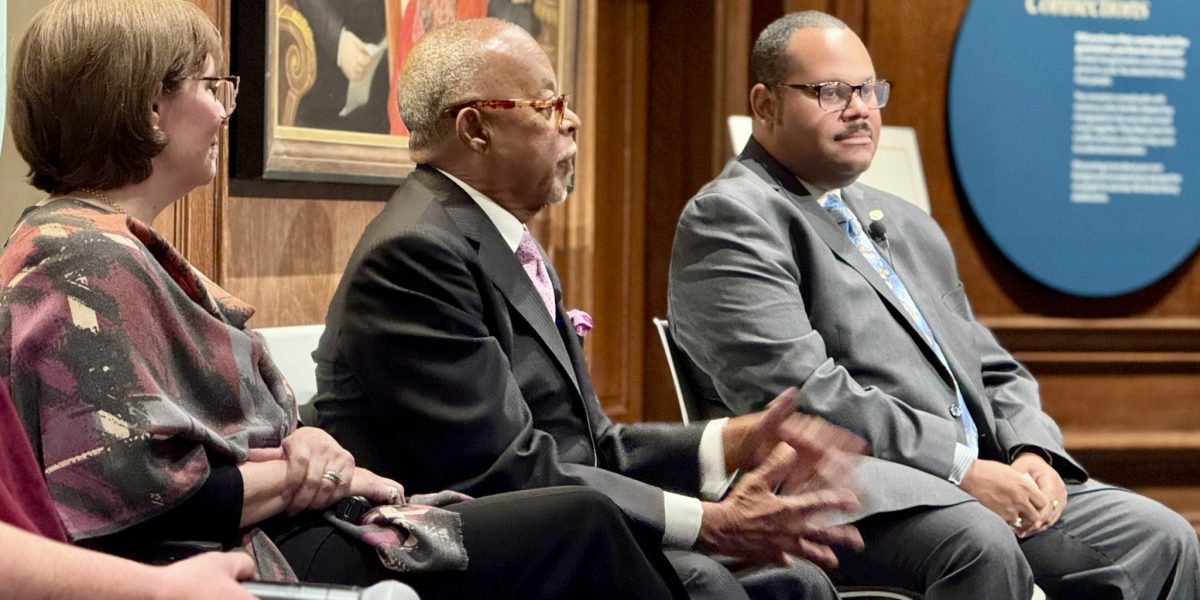
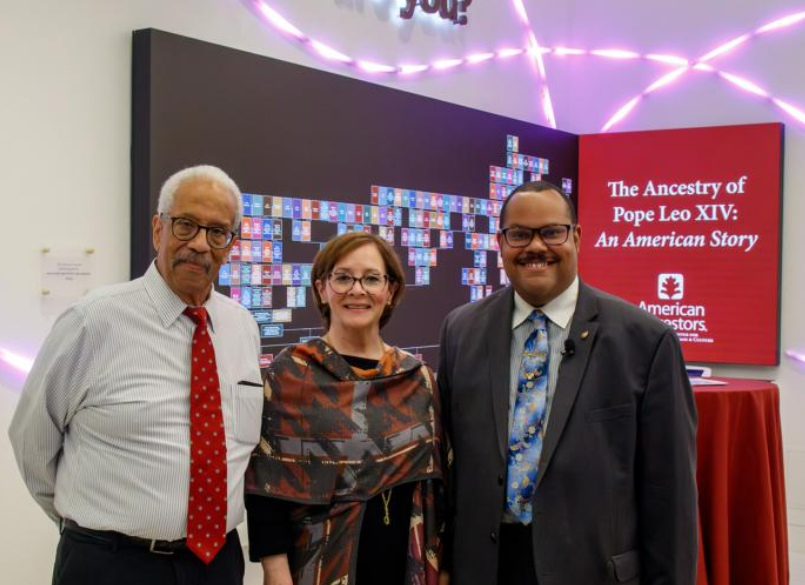
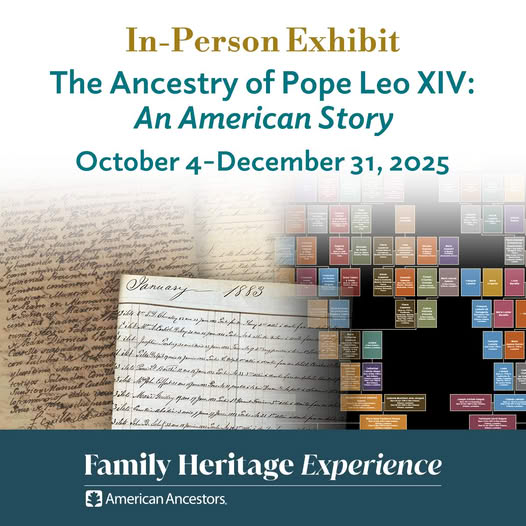
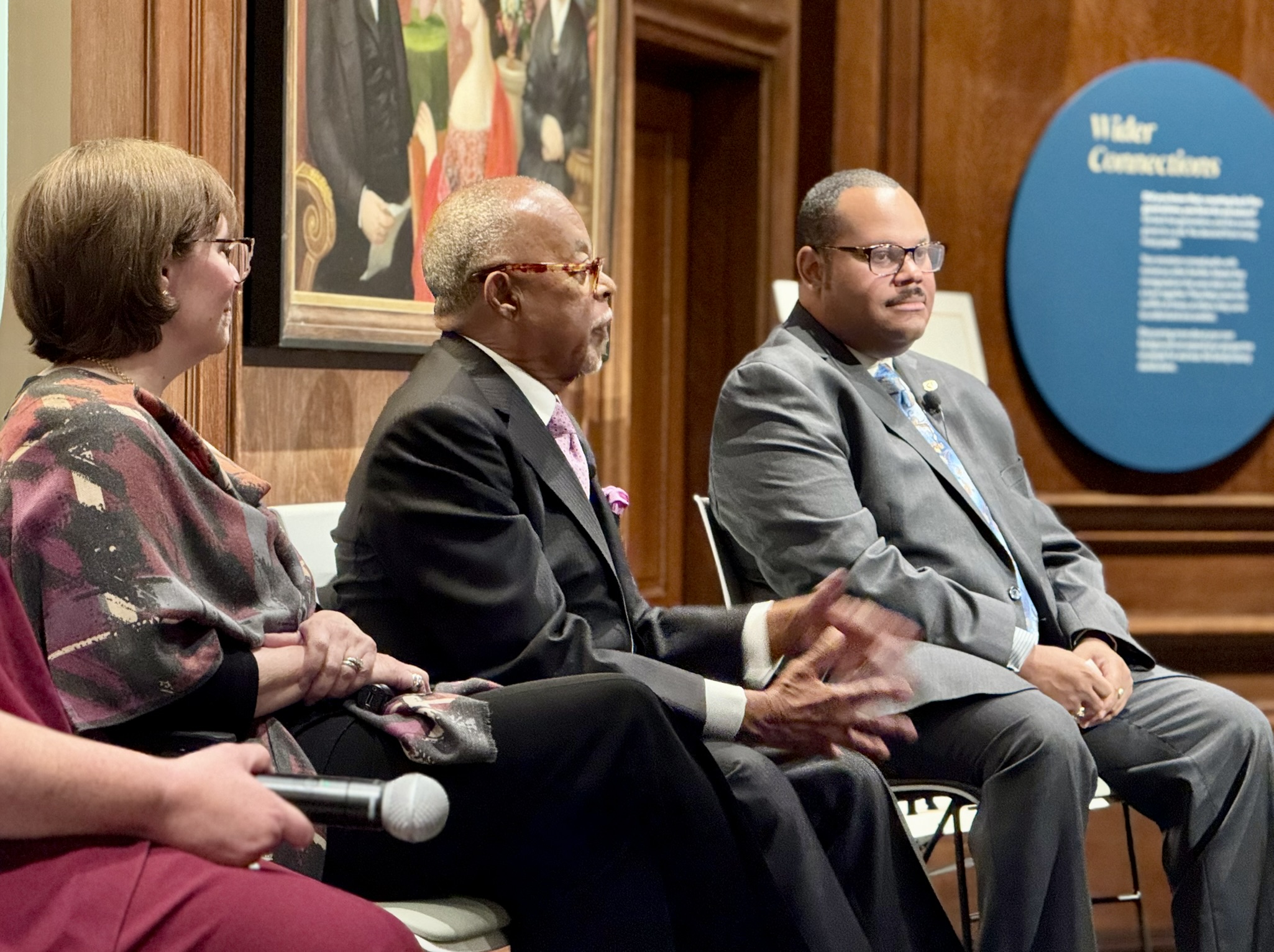
American Ancestors celebrated the opening of its new exhibit, “The Ancestry of Pope Leo XIV: An American Story,” in its new Family Heritage Experience, with a panel discussion on Oct. 3, hosted by the genealogists who researched the pope’s family history: Henry Louis Gates Jr., host of the hit PBS series “Finding Your Roots;” Lourdes Del Pino, vice president of the Cuban Genealogy Club of Miami; and Jari Honora, a New Orleans-based genealogist who uncovered the pope’s Creole heritage. Their research uncovered 14 generations of ancestors, going as far back as the late 1500s.
“What emerged was not just a papal genealogy, but an American story, one that crosses continents, centuries, and social boundaries,” said American Ancestors President and CEO Ryan Woods. “His lineage includes Spanish settlers, Haitian emigres, Cuban planters, Louisiana Creoles, freedom fighters, enslaved people, enslavers, and ancestors of African, North American, and European descent. It is, in short, a family history as complex and as layered as the histories of the Americas themselves.”
Honora’s research inspired the New York Times article that Moore read. He told The Pilot that his Catholic faith inspired his interest in the pope’s genealogy. Honora’s work was aided by sacramental records from the Archdiocese of New Orleans.
“The big surprise for me was that his mother’s family is deeply rooted in Louisiana,” he said, adding: “I was ecstatic because New Orleans is a place that values history, values family, a large percentage of our citizens are Catholics, and so I knew that they would be thrilled to know that we have a strong connection to Pope Leo.”
As soon as he heard that the pope’s name was Robert Francis Prevost, his ears perked up at the Francophone surname. He started researching and found that the pope had French and Sicilian ancestry. He explained to the panel that before the Civil War, New Orleans was “the only real metropolis in the South.” The city’s Creole culture was influenced by its Spanish, French, and African population, many of whom were Catholic. A historically lax immigration policy attracted settlers.
“This is the melting pot in which Pope Leo’s family takes shape,” he said.
Both Pope Leo XIV and Moore trace their ancestry back to Francois Lemelle, who had seven children with Marie Jean Davion. Davion was once enslaved by Lemelle, but he freed her. Some of the pope’s enslaved ancestors owned slaves after being freed. Some bought relatives to free them as well, while others reaped the economic benefits of the system that once enslaved them.
“I tell my students and audiences, just because your people were enslaved doesn’t mean, suffering is not merely — what word is the right word? — enlightening,” Gates said. “It doesn’t make you a better person.”
He said that one percent of slave owners in New Orleans were Black.
“Why should Black people be any less complicated than any other group of people?” he said.
American Ancestors is currently working on a project called 10 Million Names, which seeks to identify every man, woman, and child enslaved in U.S. territory from the 1500s to the end of the Civil War. Some of Pope Leo XIV’s ancestors will be among the names. It is extremely difficult to research the genealogy of descendants of enslaved people. Records are scarce, and many of the few that exist only acknowledge their subjects as property.
“It’s often easier to document three, five, seven generations of Cuban or Spanish, European family, than it is to just make one generation of progress with a formerly enslaved family,” Honora said.
Gates said that when Pope Leo XIV was elected in May, he received two text messages from colleagues saying, “The pope is Black!” After the article about Honora’s research was published, he received an urgent phone call from The New York Times. They wanted a full account of Pope Leo XIV’s ancestry. Gates replied that with “unlimited resources,” he and his team could produce “the definitive family tree of the pope” in five days. He knew that American Ancestors would be able to handle the work. Their research was published in The New York Times Magazine on June 11.
Gates said that with every presidential and papal election, genealogists come out of the woodwork. Amateurs flood the internet with poorly researched family trees of famous people. Gates lamented the “rubbish” trees that online sleuths have made about him. During the Pope Leo XIV project, his team pledged to “ignore everything on the internet and do it from scratch.”
“We were really amazed that we were able to find as much as we did,” Del Pino said.
She was in charge of researching the pope’s Cuban ancestors. She and her colleagues later found out that Pope Leo XIV is the descendant of Spanish nobility. One of his distant ancestors was a Knight of the Order of St. James. To be in that order, Spaniards had to prove that at least three generations of their family tree were completely Catholic and of good moral character.
“Catholicism was actually the common denominator in the colonization of the New World,” Del Pino said.
Fidel Castro would hold rallies on land once owned by the pope’s ancestors in Cuba. Gates and his wife, Marial Iglesias Utset, presented the pope with a copy of his family tree in an audience on July 5. They told him that if he ever made a papal visit to Cuba, he might find himself celebrating Mass on his ancestors’ land.
“We decided we can take it back,” the pope joked.
Moore said that he would like to meet his fifth cousin someday.
“Then my kids would get interested,” he said. “Right now, it’s old guys’ stories.”
As a judge, he does naturalization ceremonies for immigrants. He tells them that they have to think of the U.S. as a box of crayons, or as a song.
“If you want to sing the song or color the picture, you need all the colors, because all the colors are here, all the notes are here, and the picture that comes out of it is fairly unique, historically,” he said.
By Wes Cippolla, Pilot Catholic News Boston