
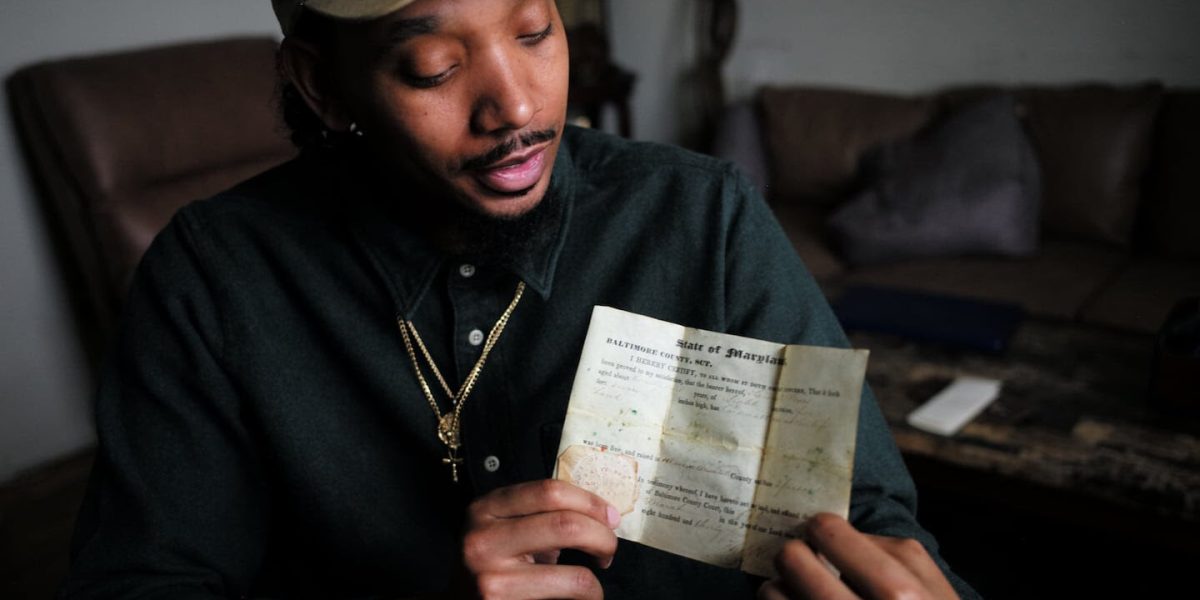
THE BOSTON GLOBE – Aaron Haynes gets choked up when he thinks about what the faded piece of parchment represents: a lineage spanning three centuries, and most importantly, his ancestor’s freedom from enslavement.
Haynes, who works as a operator on the MBTA’s Green Line, began exploring his family genealogy this winter after finding an original freedom paper belonging to one of his ancestors. The documents were proof that an African American person was free in the years before slavery was abolished. Without the papers, individuals risked being kidnapped and unlawfully sold into slavery.
Haynes’ ancestor’s document, issued in 1834, was passed down through generations to his grandmother, and stored in a hutch in his mother’s Roxbury home. He stumbled across it while cleaning, as he was dusting the contents of old cabinet.
Issued nearly 200 years ago to 21-year-old Samuel Jones in Baltimore County, Maryland, the document identifies Jones based on his physical features.
It was signed by a court official certifying that Jones was “born free,” the document says. Thirty years later, in 1864, Maryland abolished slavery when it ratified a new state constitution. After the end of the Civil War in 1865, Congress ratified the 13th amendment abolishing slavery.
“I’m getting choked up, the fact that we have this and it’s tangible. … I feel like I’m in an ancestral plane, at arm’s length from imagining what Samuel Jones looked like, what he sounded like,” said Haynes, 34.
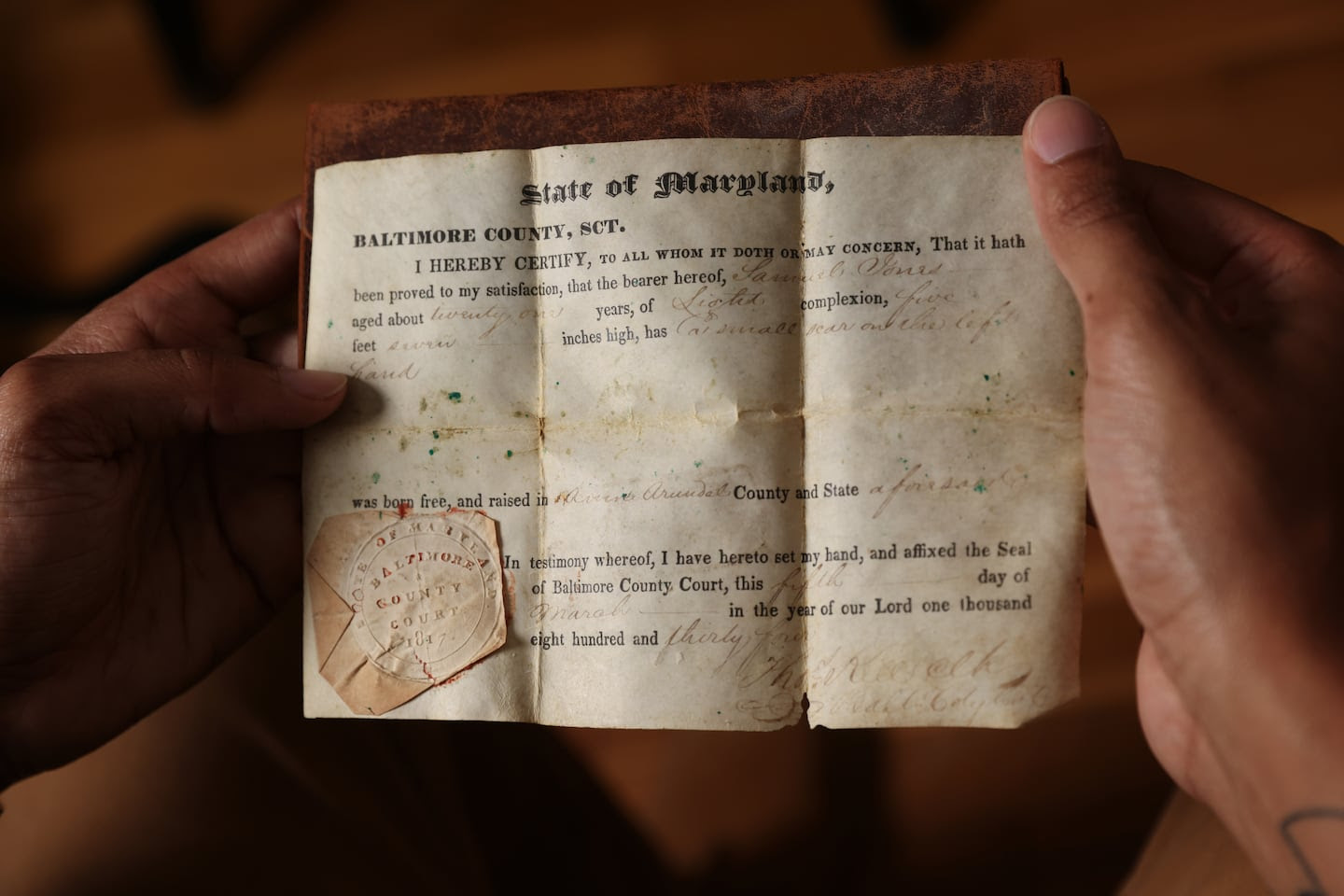
freedom paper, issued in the 1830s. Jonathan Wiggs/Globe Staff
In the early 1800s, African Americans — including many like Jones who were born free — carried their freedom papers on their person to protect against being captured and sold into slavery, according to historians. Original freedom documents are exceedingly rare, experts said.
“I’ve never held an original freedom paper in my hand before — I‘ve only seen them digitized,” said Lindsay Fulton, chief research officer at American Ancestors, a family history nonprofit in the Back Bay.
Archives at the University of Virginia in Charlottesville and an exhibit at the Senator John Heinz History Center in Pittsburgh house two of the largest collections of freedom papers, Fulton said. The National Museum of African American History and Culture in Washington, D.C., also has freedom papers on display.
Samuel Jones would have stored his freedom paper somewhere safe after receiving it in 1834, Fulton said. When it was passed down to Haynes’ mother, it was in a smaller leather folder, and it’s been remarkably well-preserved.

“The reason these documents were so critical, and in many cases saved and passed down through generations, was because they are the key to avoiding enslavement or re-enslavement right after freedom,” said Kendra Field, a historian who runs American Ancestors’ 10 Million Names project cataloguing identities of people enslaved in the US.
At first, Haynes said, he didn’t know where he could take the document to learn more about it. He considered traveling to the African American history museum in D.C., or reaching out to historians at the Museum of African American History on Beacon Hill.

In January, Haynes saw the American Ancestors building when he was on Newbury Street. When he showed researchers there the document, they immediately knew it was an stunning piece of history.
“We got so excited, because we were like, ‘That definitely looks real,’” Fulton said.
Fieldsaid the document is what historians call a certificate of freedom, because it was issued by a court. Other types of freedom papers include manumissions, which were issued by enslavers who voluntarily released someone from bondage, and lawsuits filed by people to become free, she said.
Samuel Jones’ certificate of freedom says he was 5 feet, 7 inches tall, he had a “light complexion” and “a small scar on his left hand.”
A Baltimore County Court wax seal dating from 1817 was stamped on the bottom left corner. The document isn’t made of paper, but rather parchment, which is more durable.
The document says Jones was “born free” in Anne Arundel County, which includes state capital Annapolis.
Because the document was issued in Baltimore County, it’s possible Jones got his freedom papers after moving away from his hometown to seek work at age 21, Fulton said.
It’s also possible Jones sought the document because he was in a new place with fewer relatives and connections, she said.
Haynes and other family members are researching their ancestry further after the discovery, tracing their lineage south of the Mason-Dixon line, which they didn’t know much about before.
“I’m proud that my son didn’t worry about what he might learn,” said Haynes’ mother, Michelle Kendrick. “Every family has a history, and he stepped into wanting to know his history and that’s a big step for anyone to take.”
Kendrick, 58, has lived in Roxbury her whole life, she said. The home of her grandmother, also in Roxbury, caught fire when Kendrick was a child and many family heirlooms were destroyed, she said. Jones’ certificate of freedom was salvaged.
“You don’t come across these type of documents every day,” Haynes said. “I’m just thankful she was able to save it.”
By Claire Thornton, images by Jonathan Wiggs/Globe Staff