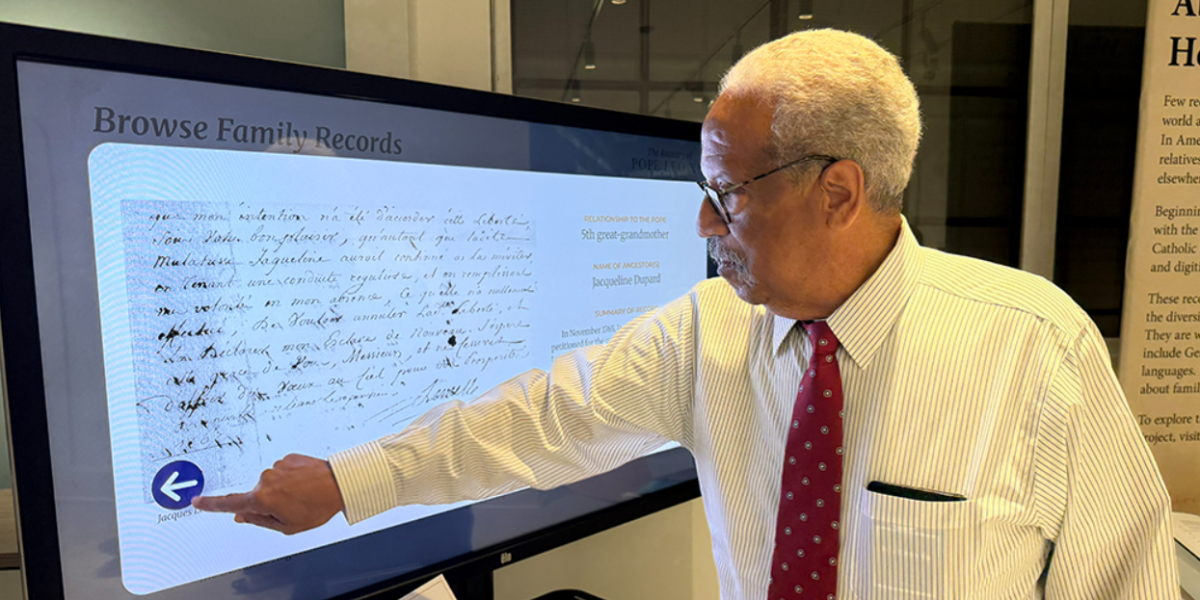
NATIONAL CATHOLIC REPORTER – Raymond Moore touched the screen on the large free-standing computer monitor, which led to a display showing a brief biographical sketch of a woman named Marie Jeanne.
Jeanne was an enslaved “mulata” counted among the property of François Lemelle in 18th-century New Orleans, according to The New York Times Magazine. In 1772, Lemmelle freed Marie Jeanne and two of the six children they had together. Lemmelle also left her one-fifth of his estate after his death in 1789.
Over the course of her life, historical records show that Marie Jeanne would own 1,040 acres of land and at least 20 slaves.
Moore descends from Marie Jeanne. So too does Pope Leo XIV, who counts her as a fourth-great-grandmother. That makes the pontiff and Moore, a 72-year-old federal judge in Colorado, distant cousins.
“I find it interesting and fascinating,” said Moore, who told NCR that his late Catholic mother — who kept framed images of Jesus, John F. Kennedy and Pope John XXIII in the family living room — would have “passed out” upon learning that she was related to a pope.

“It’s actually kind of funny,” Moore said. “Now, you go down to New Orleans, and everybody’s cousins with the pope.”
Moore was one of several people invited to the debut of “The Ancestry of Pope Leo XIV: An American Story,” a new temporary exhibit that is part of the Family Heritage Experience, a permanent interactive exhibit on family history located in Boston.
The Leo exhibit, which opened to the public on Oct. 4 and runs through Dec. 31, features a chart of the pope’s lineage that spans 15 generations, tracing Leo’s ties to freedom fighters, nobility, slave owners, slaves and modern-day celebrities that include actress Angelina Jolie and pop singer Justin Bieber.
The exhibit is also intended to shed light on Leo’s Creole and Latin American heritage, as well as his ancestral ties to New Orleans, Cuba, Haiti, Italy and beyond.

Raymond Moore, right, studies an interactive exhibit displaying the family tree of Pope Leo XIV, his distant cousin. (American Ancestors/Claire Vail)
“When your genome is as diverse as Leo’s, you need an army” of researchers, Gates said during an Oct. 3 panel discussion at the Family Heritage Experience.
Gates, the host of the Emmy-nominated PBS show “Finding Your Roots,” earlier this year met with Leo at the Vatican, where he presented the pontiff with a printout of his family tree. According to The Harvard Gazette, Gates told Leo the tree went as far back as the pope’s 12th-great-grandparents, who were born 500 years ago when Leo X sat on St. Peter’s throne.
Gates told the audience at the panel discussion that he informed Leo that several of his ancestors — white and Black — owned slaves, including Marie Jeanne. Gates said he was particularly interested in her story.
“She was in it for business,” he said. “I found that fascinating.”
The new exhibit illustrates how Leo’s ancestry reflects the history of American migration. His ancestors were born in France, Italy, Spain, Cuba, Canada, Haiti and the United States, among other countries.

“When your genome is as diverse as Leo’s, you need an army” of researchers, Gates said during an Oct. 3 panel discussion at the Family Heritage Experience.
Gates, the host of the Emmy-nominated PBS show “Finding Your Roots,” earlier this year met with Leo at the Vatican, where he presented the pontiff with a printout of his family tree. According to The Harvard Gazette, Gates told Leo the tree went as far back as the pope’s 12th-great-grandparents, who were born 500 years ago when Leo X sat on St. Peter’s throne.
Gates told the audience at the panel discussion that he informed Leo that several of his ancestors — white and Black — owned slaves, including Marie Jeanne. Gates said he was particularly interested in her story.
“She was in it for business,” he said. “I found that fascinating.”
The new exhibit illustrates how Leo’s ancestry reflects the history of American migration. His ancestors were born in France, Italy, Spain, Cuba, Canada, Haiti and the United States, among other countries.
At least 17 of the pope’s American ancestors were Black. As Gates wrote for the New York Times Magazine, they were described in historical records in terms that included “negresse,” “free person of color,” “quadroon” and “mulâtresse créole.” According to media reports, his maternal grandparents, Joseph Martinez, who was born in Haiti, and Louise Baquié, were identified as Black in the 1900 census while living in New Orleans.
Taking the pontiff’s ancestors into account, Gates estimated that if Leo were to take a DNA test, it likely would indicate that he is 10% to 15% Black.
“The pope’s ancestors, as late as the 20th century, right down in New Orleans, were identified as people of color,” said Jari C. Honora, a New Orleans-based genealogist who helped research Leo’s family tree.
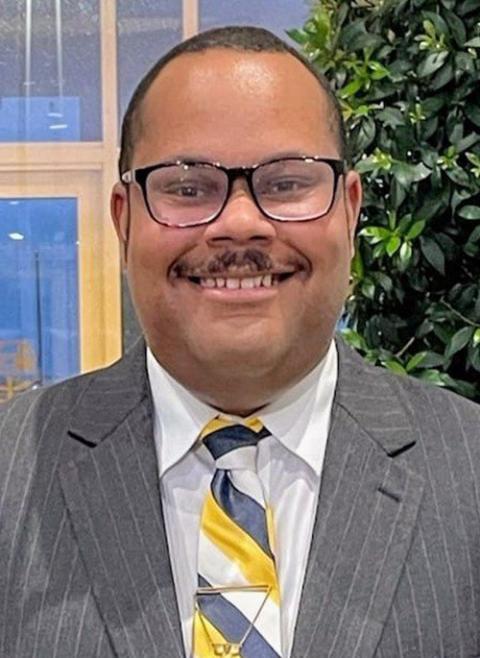
Jari C. Honora, seen in an undated photo (OSV News/Courtesy of Jari C. Honora)
During the panel discussion, Honora said that Leo’s family took shape in the melting pot that was New Orleans in the centuries before the Civil War. He noted that the pope has ancestors who as recently as 1834 were recorded as being enslaved in that city.
Lourdes Del Pino, a Cuban genealogist with the Cuban Genealogy Club of Miami, spoke about one of the pope’s maternal relatives,* Antonio José de Sucre. The New York Times Magazine’s feature said de Sucre played a decisive role in defeating Spanish colonialism throughout Latin America in the 1824 Battle of Ayacucho.
“That battle was fought in Peru,” said Pino, who noted the pontiff’s connection to Peru in his two decades as an Augustinian missionary and later as bishop of Chiclayo.
The exhibit features records documenting information about the pope’s ancestors and offers contextual explorations of themes such as immigration, race, slavery and freedom that are woven through his family lineage. In those stories, Woods said visitors will find universal truths about the human experience and personal details that make every family unique.
“What an exhibit like this shows,” Woods said, “is that there is a possibility that when you have a question and you follow your curiosity, there are answers. And when you find answers in your family history journey, it reveals stories and people that help you feel more connected, not only to your family but to stories and history, and perhaps our common sense of humanity.”
This story has been updated to specify that Antonio José de Sucre was a maternal relative of the pope.
By Brian Fraga, Staff Reporter