
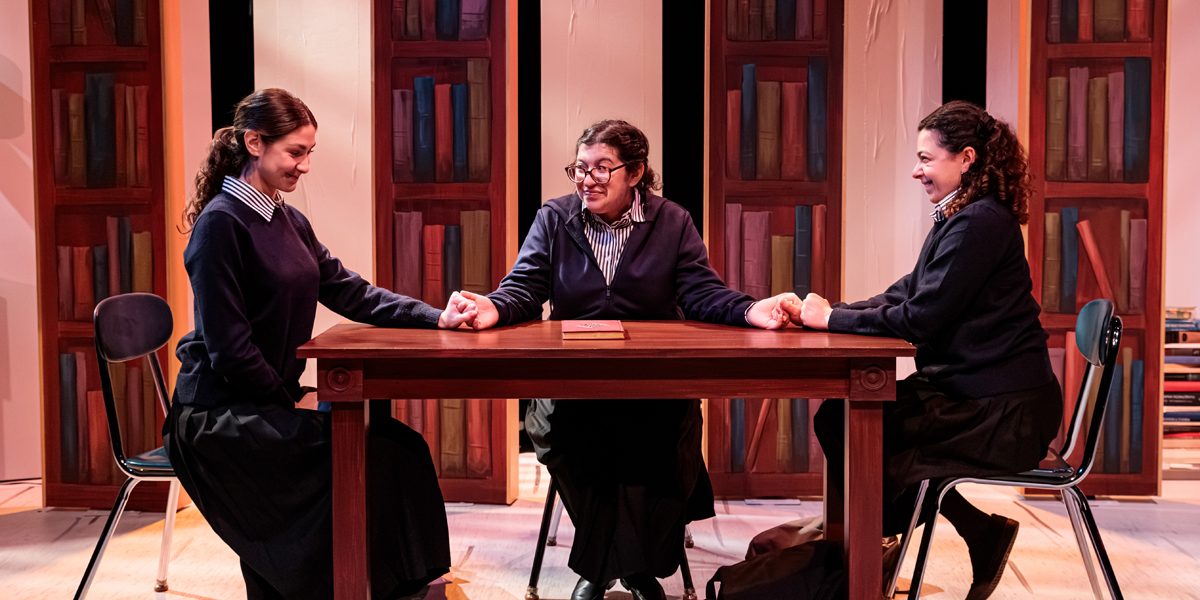
In “Jessica of Venice,” three Orthodox schoolgirls discover a banned copy of “The Merchant of Venice

JEWISH JOURNAL – Rachel Beth Greene has a special relationship with her new play “Jessica of Venice.” “My favorite thing is how it’s personal,” said the Boston-based playwright. In fact, the drama’s premiere production at Boston Playwrights’ Theatre – as part of its Fall Rep Festival (along with “White Phoenix” by Yide Cai) is considered her thesis for her MFA in Playwrighting at Boston University.
While the play is not meant to be autobiographical, the script significantly reflects her own experience at Ohio’s Modern Orthodox Fuchs Mizrachi School where she Greene studied Mishna, Talmud and Halacha.
“We had to wear skirts,” she noted. Given the important presence of Hebrew, Yiddish and Aramaic terms in her play, she has added a glossary at the end of the script – including such words as Shidduch (a match), Amidah (the standing prayer) and even the text of Tefillat Ha-Derech (The Traveler’s Prayer). Greene has also been greatly influenced by maternal grandmother Shulamith Erenberg – a Hebrew teacher and “a long inspiration in my life.”
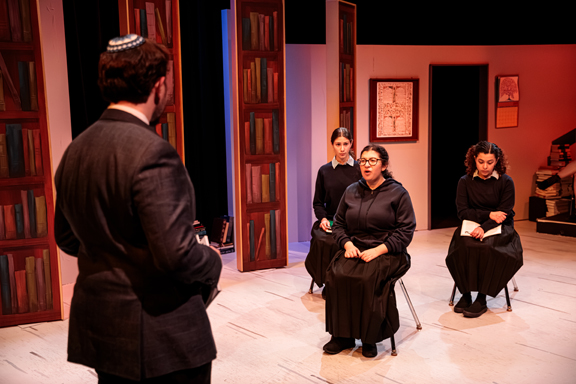
Considering her extensive Jewish education and traditional background, it should come as no surprise that “Jessica of Venice” not only focuses on a fictional trio of Ohio Orthodox schoolgirls but also connects with Greene’s own ongoing exploration of Shakespearean plays and characters. At the start of her play, that exploration convenes in a forgotten library where the three Orthodox schoolgirls in question – Shaina (Lindsey Wildstein), Hannah (Ella Blumenthal) and Aliza (Margo Segal) – discover a banned copy of “The Merchant of Venice.”
All three 17-year-olds take an interest in the character of Jessica, the daughter of Jewish creditor Shylock. Eventually, protagonist Shaina resembles Shakespeare’s Jewish runaway (who falls for non-Jewish Lorenzo) as she crushes on a Christian boy named Logan (Gavin Mariani) from her driver’s ed class. At the same time, Shaina and her fellow classmates find themselves falling in love with theater.
“It’s a play about teenage girls doing magic,” said Greene.

Throughout “Jessica of Venice,” Greene noted, her central goal is to explain “why would this girl choose to run away.” While working on that goal, she means to “see what this character (the Shakespeare one) means to highschoolers.”
Under the direction of Josh Glenn-Kayden, the production strives for authenticity, and includes a Yeshivah dialect for the Jewish terms essential to Greene’s play.
“Jessica of Venice” runs from Nov. 12-15, and from Nov. 18-22 at the Boston Playwrights’ Theatre.
By Jules Becker
Images by Benjamin Rose Photography