‘White Phoenix’ and ‘Jessica of Venice’ trace lives divided between East and West, faith and freedom, revealing the cost of bridging that divide
New works paired in overlapping November repertory productions
McGRATHPR.com – … Boston Playwrights’ Theatre (BPT), Boston University’s award-winning professional theatre dedicated to new work, presents its “Fall Rep Festival,” featuring two new plays running in repertory November 5 through 22 at 949 Commonwealth Avenue, Boston: Yide Cai’s “White Phoenix,” directed by Dmitry Troyanovsky, and Rachel Beth Greene’s “Jessica of Venice,” directed by Josh Glenn-Kayden. The pairing brings together two distinct worlds: a Chinese family torn apart across an ocean, and an Orthodox Jewish community set in the present day. Performed on the same stage, the two plays ask a shared question: what is the cost of crossing the distance between two worlds?

Told by just two actors, “White Phoenix” is a sweeping family drama that unfolds across decades and continents. The play follows a Chinese orphan who vows to find the sister he lost, tracing his path to adulthood in China alongside a dangerous entanglement with the daughter of a powerful political family. Meanwhile, his sister comes of age an ocean away, adopted into a prominent American senatorial family and drawn into a secret romance of her own. As their two stories finally converge, the siblings’ long-awaited reunion becomes a mirror for the fraught, complicated relationship between their two countries.
Cai, whose writing draws on classical Chinese drama, particularly “The Peony Pavilion,” built the epic for a cast of two on purpose. “The audience will serve as witness to the effort of two actors embodying four distinct, almost opposite characters,” he says. “It’s this magic of making something out of nothing. That’s what’s always special about theater: the imagination. Even though the two siblings spend the entire play trying to find each other, the two actors playing them are together on stage the whole time.”
Cai is writing against the habit of treating nations as people. “We tend to assume the country or the government and the people who live in it are the same thing,” he explains. “Instead of symbols, my characters are the opposite: prisoners and victims of the countries they belong to. There is China everywhere in America, like TikTok, bubble tea and rare earth minerals, and America everywhere in China, like Starbucks and Hollywood movies. But neither side really wants to talk about it with clarity.”
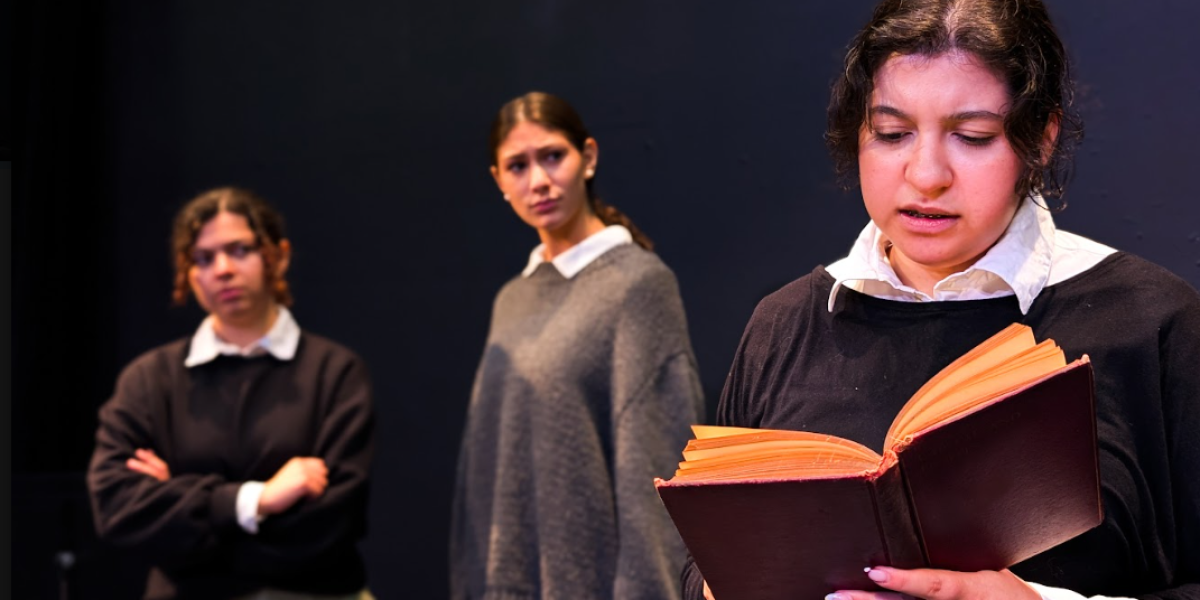
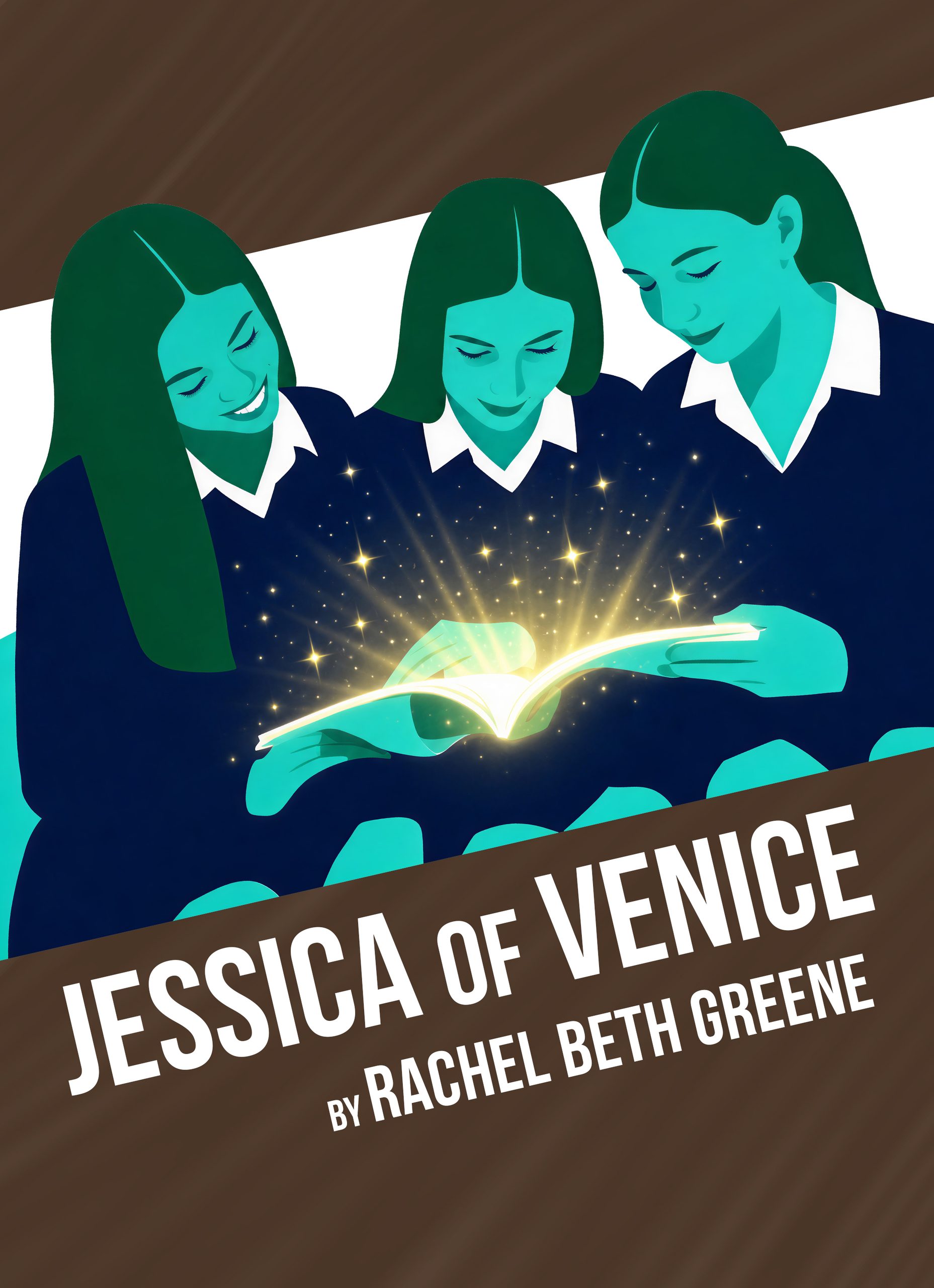
Set in the present day but steeped in Early Modern echoes, “Jessica of Venice” follows a group of Orthodox Jewish schoolgirls who discover a banned copy of Shakespeare’s “The Merchant of Venice” and become fascinated by its rebellious runaway daughter. For one restless teen caught between her tight-knit community and a budding crush outside it, the discovery starts to blur the line between the story on the page and the life she’s beginning to imagine for herself.
Greene, a self-described Shakespeare buff, grew up in the observant Jewish world she depicts. “Jessica is so often portrayed as selfish and coldhearted towards her father,” she says. “But rarely is she considered within her context: as a curious, sheltered young girl with big dreams. I too was raised in the observant Jewish world and understand how it feels to struggle with the practices of traditional religious life as an ambitious, inquisitive teenager.” She links the play’s close reading of Shakespeare to Torah study, where students read “between the lines” of texts centered on male protagonists to expand their understanding of the world.
Greene writes with outsiders in mind. “I am acutely aware that most audience members will have never set foot in a Hasidic Jewish community,” she notes. “Audiences should expect not to know every single word spoken onstage. But if I’ve done my job right, that will not stand in the way of them understanding the story – in fact, it might even help.” She adds that the play has no villain: “I believe these characters all act from a place of good, if often mismatched, intentions.”
Staged side by side, the two plays speak to each other. “A theme we have discovered that runs between our stories is the idea of characters who inhabit two separate worlds, and the yearning to reach through the space between them,” says Greene. For Cai, the pairing points to a shared warning: “Heaven is in the making, in the everyday life we already have, with the people already around us. The moment we idolize or covet an elsewhere, or an ‘other,’ we create our own downfall.”

courtesy image
courtesy image
Both playwrights resist an easy verdict on what separation costs. “Before we ask whether the cost was worth it, we need to acknowledge and honor the cost, and the suffering of the people who bore it,” says Cai. Greene leaves the question with the audience: “These conflicts are too intricate and fraught for a ‘right answer.’ I hope the audience leaves the theater pondering this very question.”
“On the one hand, it is devastating watching characters in these plays be willing to sacrifice almost anything to escape from the communities that made them,” said BPT Artistic Director Megan Sandberg-Zakian. “But on the other, there is something inspiring about characters who dream of a better world, and believe, against all odds, that there is a place somewhere that will offer them the opportunity to feel fully themselves. It’s an inherently optimistic – and very American – kind of dramatic action.”
The creative teams include Stage Managers Jess Brennan* (“White Phoenix”) and Erin Lerch* (“Jessica of Venice”). *Appearing through an Agreement between Boston Playwrights’ Theatre and Actors’ Equity Association, the Union of Professional Actors and Stage Managers in the United States.
Fall Rep Festival Details
“White Phoenix” by Yide Cai, directed by Dmitry Troyanovsky, featuring Philip Zeng* as Li CunYi and Gabriel Bradford, with Serena Zhu as Li CunXin and Zhao YanYan.
*Appearing through an Agreement between Boston Playwrights’ Theatre and Actors’ Equity Association, the Union of Professional Actors and Stage Managers in the United States.
Performances: Select dates from Nov. 5 through 22
Thursday, November 5 at 7:00 pm
Friday, November 6 at 8:00 pm
Saturday, November 7 at 8:00 pm
Saturday, November 14 at 2:00 pm**
Sunday, November 15 at 7:00 pm**
Thursday, November 19 at 7:00 pm
Saturday, November 21 at 8:00 pm**
Sunday, November 22 at 2:00 pm**
Pay-What-You-Want Previews: Thurs., Nov. 5, 7 pm, and Fri., Nov. 6, 8 pm
Post-show Conversation: Thursday, November 19, after the 7 pm performance
Content transparency: “White Phoenix” contains an extended depiction of a consensual romantic relationship between adopted siblings. No violence is depicted onstage, but the play contains descriptions of war, political violence, and international child trafficking. Details, including spoilers: bostonplaywrights.org/ct/phoenix
“Jessica of Venice” by Rachel Beth Greene, directed by Josh Glenn-Kayden, featuring Lindsey Wildstein as Shaina; Margo Segal as Aliza and Brooke; Ella Blumenthal as Hannah and Kaiden; Gavin Mariani as Logan; Dave Rabinow* as Shlomo; Jessica Golden as Rivka; and Luke Avilez Meisel as Rabbi Farkas and Mr. Burski.
*Appearing through an Agreement between Boston Playwrights’ Theatre and Actors’ Equity Association, the Union of Professional Actors and Stage Managers in the United States.
Performances: Select dates from Nov. 12 through 22
Thursday, November 12 at 7:00 pm
Friday, November 13 at 8:00 pm
Saturday, November 14 at 8:00 pm**
Sunday, November 15 at 2:00 pm**
Wednesday, November 18 at 7:00 pm
Friday, November 20 at 8:00 pm
Saturday, November 21 at 2:00 pm**
Sunday, November 22 at 7:00 pm**
Pay-What-You-Want Previews: Thursday, November 12, 7 pm, and Friday, November 13, 8 pm
Opening/Press Night: Saturday, November 14, 8 pm, followed by the Fall Rep Opening Reception
Post-show Conversation: Saturday, November 21, after the 2 pm performance
Content transparency: “Jessica of Venice” includes depictions of religious oppression, antisemitism and misogyny. No violence is depicted onstage, but the play does contain descriptions of graphic content including a sexual assault. Details, including spoilers: bostonplaywrights.org/ct/jessica
The Fall Rep Pass** allows audiences to experience both plays on the same day on four dates: Saturday, November 14 (“White Phoenix” at 2 pm, “Jessica of Venice” at 8 pm, followed by the Fall Rep Opening Reception); Sunday, November 15 (“Jessica of Venice” at 2 pm, “White Phoenix” at 7 pm); Saturday, November 21 (“Jessica of Venice” at 2 pm, “White Phoenix” at 8 pm); and Sunday, November 22 (“White Phoenix” at 2 pm, “Jessica of Venice” at 7 pm). The Fall Rep Pass, $50 for both plays, is available at bostonplaywrights.org.
Tickets are available exclusively at bostonplaywrights.org. Single tickets: $40 adults; $25 BU faculty/staff, veterans and seniors (62+); $15 students with valid ID; free student rush for all students with valid ID, available day-of-performance at the Box Office. Each production also offers Pay-What-You-Want previews, where audiences select the amount they pay, including $0. For group rates, contact Matt Hecker at mattheck@bu.edu.
Boston Playwrights’ Theatre is the only authorized seller of tickets for its productions. To ensure fair pricing and guaranteed entry, tickets should be purchased exclusively through bostonplaywrights.org or the BPT box office. Tickets purchased through third-party sellers or unauthorized websites may be invalid, overpriced, or fraudulent.
For tickets, the complete performance schedule, and more information about the Fall Rep Festival, visit bostonplaywrights.org, and follow Boston Playwrights’ Theatre on Facebook and Instagram.
About Boston Playwrights’ Theatre

Boston Playwrights’ Theatre (BPT) is an award-winning professional theatre dedicated to new work for the stage, founded in 1981 by Nobel Laureate Derek Walcott. Part of the Boston University Office for the Arts and led by Artistic Director Megan Sandberg-Zakian, BPT produces a full season of new plays each year, developmental readings of works in progress, and the iconic Boston Theater Marathon, an annual all-day “marathon” of new ten-minute plays by New England playwrights. BPT alumni have seen their work produced on Broadway, on Netflix, and at regional theatres across the country and around the world; they include Melinda Lopez, Ronán Noone, Molly Smith Metzler, Alexis Scheer, Eliana Pipes and Karen Zacarías. For more information, visit bostonplaywrights.org, and follow Boston Playwrights’ Theatre on Facebook and Instagram.