Researchers in Boston are diving deep into his family tree to connect the missing links
WCVB Ch. 5 Boston – Anne Arundel County, Maryland, was once home to a man named Samuel Jones who had to carry around a piece of paper to prove he was born a free man.
It’s a piece of paper Jones might never have imagined lasting for nearly 200 years, much less remaining in the possession of his descendants in Boston in the year 2026.
Aaron Haynes discovered it for the first time in 2020, helping his mom clear out her home during the COVID-19 lockdown.
“And I opened it up and looked at it and was very confused as to what this might be,” he said. “And she said, ‘That’s your ancestor’s freedom papers.’ And I said, ‘Hold on!'”
Haynes, who hadn’t previously known about the document, was hungry to learn more. Inside a small leather pouch was a tri-folded beige document that appeared to be old. But how this document was made and how it made its way to him was unclear.
Haynes, whose work often has him driving up and down Newbury Street in Boston, found a beacon of opportunity on that very street.
“I think that the fact that I’ve driven by here multiple times. It was just like, let me just connect these two dots and see where it leads me,” said Haynes.
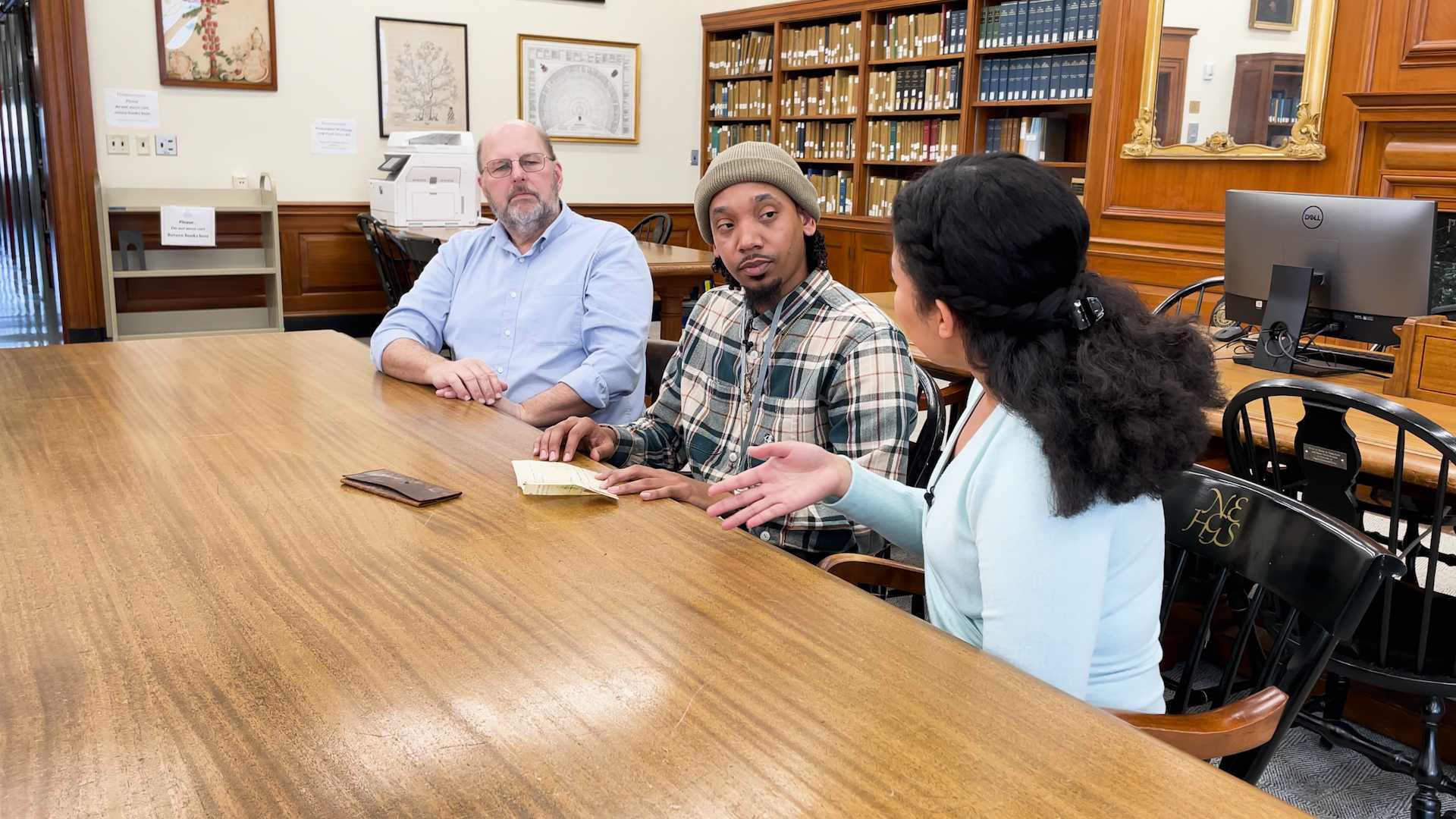
Where it led him was to a library inside American Ancestors on Newbury Street on a late January day. Originally known as the New England Historic Genealogical Society, it is the oldest genealogical society in the United States, billing itself as a national center for family history, heritage and culture.
Haynes put in a call in early January with his questions, then found himself in that library on the precipice of answers.
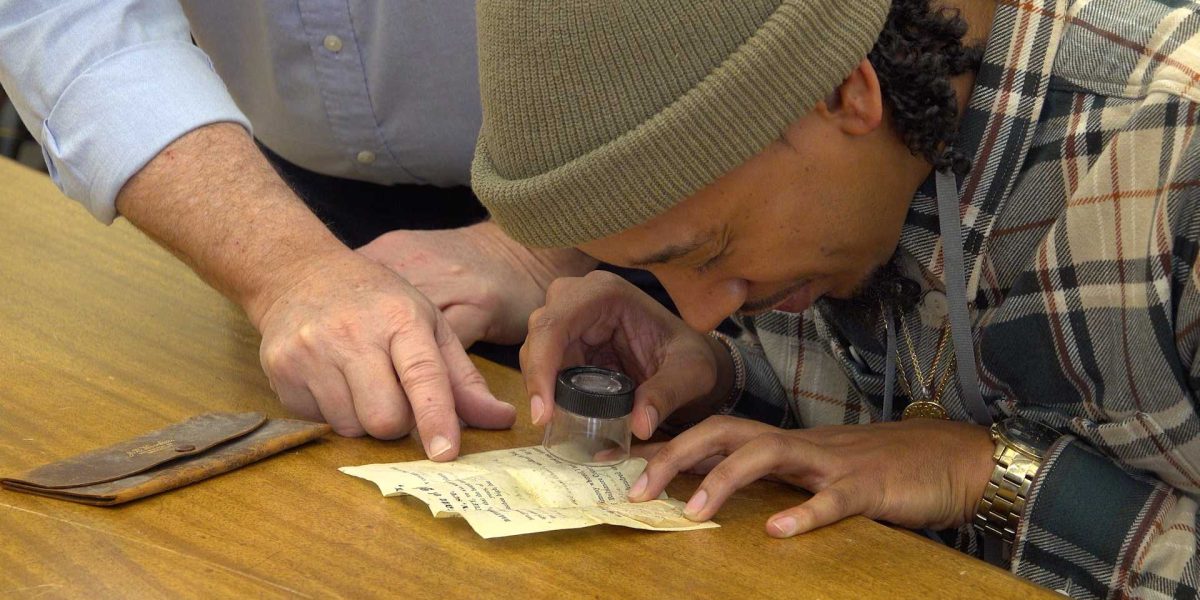
Sitting to his right at a table in the library was conservator Todd Pattison, whose interest in document restoration and preservation began with a Boy Scouts badge in his youth.
“I like the materials, I like the materiality of things,” he said. “I like the paper, I like the ink, whether it’s printing ink or manuscript ink. I like the bindings. I like the structure. I like to see how things were produced in the time that they were done.”
Pattison’s training and experience allow him to closely examine the fibers and fonts of historic manuscripts to determine the real from the recreated.
“Paper technology has changed over time,” explained Pattison. “So paper was handmade until the beginning of the 19th century, when paper-making machines were introduced. But of course, they weren’t adopted everywhere, so that adoption was slow. So it’s really not until the 1830s you have a lot of machine-made paper.”
Clues he can unlock just by touching a paper can aid him in discovering what it’s made of, how it was made and how old it might be.
“We hold about 25 million pieces of manuscript material here in our collections,” said Pattison, “so I do get a chance to see a lot.”
But up until this moment in the library, he had never seen a document like the one Haynes brought in. Pattison said there’s a reason for it.
“Generally, we don’t have as much material from more marginalized people, from people that didn’t have access to collections and weren’t collected by institutions,” said Pattison. “I think there has been a bias in institutional collecting that we collect, you know, Founding Fathers materials, and we collect wealthy people because we have historically tried to tell that story.”
It’s a scenario the historian at Haynes’ left understands well.
“These names were hidden for a very long time, purposefully obscured, and so just locating the names is a huge effort,” said Danielle Rose.
Rose works with the 10 Million Names Project, an effort housed in American Ancestors that works to recover and restore the names of enslaved people across the United States.
“I think a lot of people don’t think about what they may have in their home when it comes to contributing to history,” said Rose.
At the table in the library, with Rose and Pattison at his side, Haynes began to unfold his contribution. And right away, Pattison could tell it was both a legitimate and very old document, identifying it immediately as parchment.
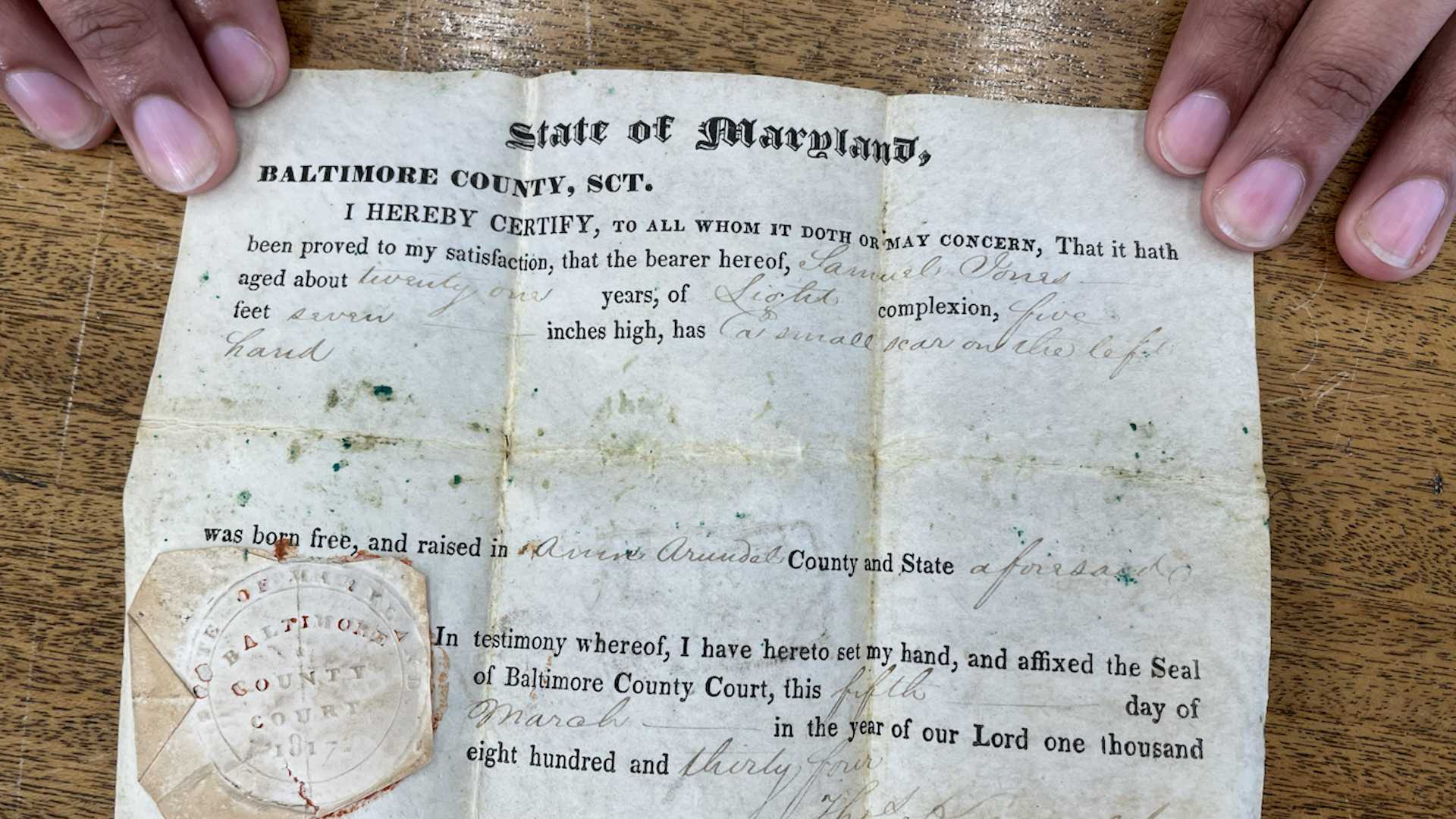
“The 1817 would be just the seal date, but the actual document would have been produced in 1834,” Pattison explained to Haynes, noting the text printed on the document.
“OK, wow,” said Haynes in response.
“It’s quite impressive,” Pattison replied.
Impressive because the document is intact, the text is still legible, and in the corner, there is a name, Samuel Jones. The document says Jones was 21 when it was signed, declaring him a man born free and raised in Anne Arundel County, Maryland.
“A lot of free Black people wanted, needed, to carry these documents so that they could avoid potential recapture, kidnapping, back into enslavement,” Rose said.
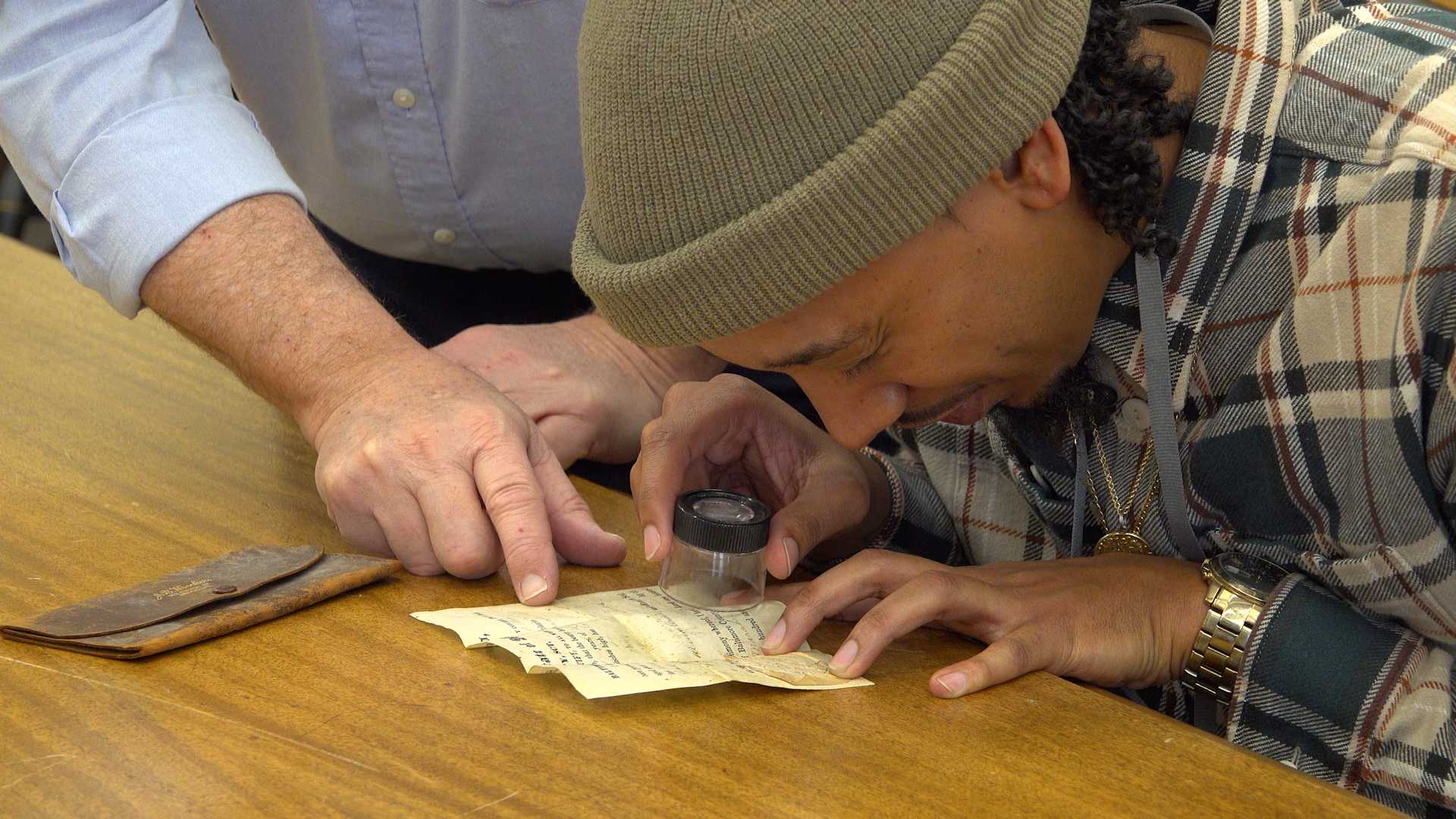
The document also described Jones as having a light complexion, standing 5-feet-7-inches and having a small scar on his left hand.
“The more documents that you can find for African Americans, especially before the end of the Civil War, it’s a real treasure,” said Rose.
While this treasure is light and thin, for Haynes it is heavy with history, honor and empowerment.
“Knowing that probably I’m here because he did this step,” said Haynes. “Just a feeling of being grateful of what I have and feeling grateful for what my family has been through and knowing that through these trials and tribulations we can just overcome any obstacle.”
One obstacle down and one question answered is now a door open for more research into the past.
“I haven’t realized just how much it just weighs in on just the history of not just my family but of this country itself,” said Haynes. “And what it means to be just as an African American man, knowing that I have a relative’s freedom papers.”
Researchers at American Ancestors are working with Haynes to research the family tree and better understand the link between Jones and Haynes’ great-grandmother Charlotte, who handed the document to her daughter, Janet Kendrick, who passed it on to Haynes’ mother, Michelle Kendrick.

By Leanna Scachetti, WCVB Boston